
Vertical Rescue: Another Chapter In The Ongoing Saga Of Great Lakes Lifesaving – Winter 1983

~
The Great Lakes… 84% of the continent’s fresh water… a different story in every drop.
By James P. Barry
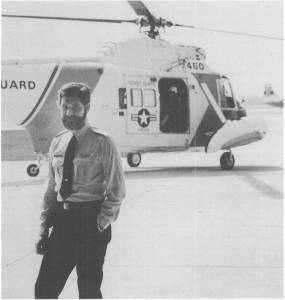
James P. Barry standing in front of rescue chopper.
Image from Inland Seas 1983 Winter issue.
Lieutenant Commander Dennis Robbins is a slim, erect man with a dark, neatly trimmed full beard that on first acquaintance gives him an Edwardian air. One can imagine him near the turn of the century on the open bridge of a gale-swept steamer or, like Joseph Conrad, on the quarter-deck of a sailing ship. Instead, his usual command is a U.S. Coast Guard helicopter.
Until recently he was assigned to U.S. Coast Guard Air Station Chicago, which watches over the southern half of Lake Michigan, including the major ports of Chicago and Milwaukee. It consists of 35 people, of whom ten are pilots.
One day in the hangar of the Chicago station, Robbins leaned back in his chair with a mug of coffee and talked about the work. He speaks quietly with only an occasional gesture. His beard, which has a slight thread of gray- he is in his mid-thirties-does not hide a ready smile.
He was born and grew up in Hammond, Indiana, a southeastern suburb of Chicago that nestles close beside Gary on the Lake Michigan shore. As a boy he visited the Indiana dunes and swam in the Lake, “but one of my biggest fears was getting trapped in the steel mills like everybody else.”
Since his high school days he had been interested in the Coast Guard. His first few years gave him duty in the North Atlantic, Los Angeles Station, Arctic, Antarctic, Brooklyn and Puerto Rico.
After that he was assigned to Chicago, close to Hammond, where his parents still live. “I did that intentionally. My parents are in their seventies, and I’m an only child. It’s a good time to be closer to home.”
Coast Guard activity is not necessarily less dangerous in the Chicago area. Just before Robbins joined the station, one of its helicopters, flying over the Illinois River in January to observe an ice build-up, flew too low, hit some wires, crashed, and went under the ice. The two officers and one crewman aboard were lost.
He makes another comparison between the Great Lakes and the oceans, “The Lakes tend to kick up quickly – here it goes from calm to 12-foot seas and back to calm in just a few hours. You don’t find that on the oceans. And the pleasure boaters here do seem to be aware of that. They seem to keep a better eye on the weather and don’t take the chances I’ve seen people take on the oceans.”
When one of the Chicago helicopters rescues someone, the usual procedure is for it to hover and lower a basket – a shallow, metal-pipe arrangement open at the top – on the end of a steel cable that drops from a short arm on the side of the aircraft. A hydraulic winch is operated by a crewman stationed just inside the big sliding side door. The person being rescued scrambles into the basket when it reaches him and is drawn up to the helicopter door.
Both pleasure boatmen and working boatmen get into trouble from time to time. “Winter before last at the end of one of our big blizzards the execu- tive officer and I had the duty and we had a tremendous amount of snow and at the very end of that, as soon as the weather broke, we went down here right off downtown Chicago and hoisted three or four guys off a com- mercial fisherman that was caught in the ice. They’d been stuck in the ice in the blizzard and they were cold and wanted off.”
On other occasions, when the person to be taken aboard has been injured or is ill, the procedure must be a little different.
“Last fall I took a possible heart attack victim off a Standard Oil tanker.
We went out and put a corpsman down on the vessel.”
It is difficult for a helicopter to hover, even though its ability to do so is one of the things that makes it useful, so the aircraft circled while the medical corpsman examined the sailor and decided that he should be evacuated.

Rescue helicopter mid-rescue. Image from Milwaukee Journal.
The Photinia Rescue
On Friday, 12 May 1978, the British ocean freighter Photinia lay at her port anchor outside Milwaukee harbor, waiting to load grain. The barometer fell. By 3:30 Saturday morning there was a 50-knot wind. The second mate, on watch, called the ship’s master, Austin P. Collins. Captain Collins arrived on the bridge at 4:00 and quickly decided to take his ship out into the open Lake for safety.
But the steam boiler that powered both the steering gear and the anchor winches of the Photinia did not function properly. Captain Collins was forced to wait while the engineers repaired it. Meanwhile his ship dragged her anchor and was driven southward, roughly parallel to the shore. Just before 6:00 A.M. he had the starboard anchor let go, but it did not hold either. He radioed the Coast Guard station at Milwaukee for a tug, but the station had no tug. He called a commercial towing company but could get no answer.
By 7:20 the boiler was repaired. The captain rang slow ahead on the engineroom telegraph and ordered the winches started to bring in the anchors. But about 7:20 the men at the winches discovered that the port and starboard anchor chains had crossed and were twisted around each other; the ship was tethered to two useless anchors that could not be taken in. Meanwhile the gale began to throw her around so violently that at one moment her bow was pointed into the wind and at the next, almost opposite. Waves damaged the ship’s gangway, thirty feet above the water. There was a steady rain.
As the vessel drifted southward she moved generally parallel to land, but she also moved closer to it. And some distance south of the harbor the shore curved out into the Lake. Just before 1:00 P.M. she first touched bottom, but the wind and the waves continued to push her nearly 2,000 feet farther through the shoal waters. She finally came to rest about 500 yards off shore with her stern pointing northeast into the gale, and her bow southwest and lying nearer land. Her rudder, propeller, and stern frame were damaged and she had several holes in her bottom.
As it became evident that the ship might go aground, Captain Collins called the Coast Guard station at Milwaukee and told them that if that did happen he wanted his men taken off, for under the circumstances his vessel could easily break up or roll over. But there was no way that boats could reach the ship in those seas, and so the Milwaukee station called the Chicago Air Station.
Dennis Robbins was the senior officer on duty there that Saturday morn- ing. He, a copilot, and a crewman immediately dressed in cold weather flying gear of wet suits and flight helmets. The wet suits are like those worn by scuba divers and are for protection in case the flyers come down in the frigid water. The helmets, which look like slightly larger versions of motorcyclists’ crash helmets, contain earphones and microphones and shield the wearers’ ears from the helicopter noise.
Robbins and his two assistants took off in an HH-52 helicopter – a medium-sized one built by Sikorsky – and headed north toward Milwaukee, flying under the low cloud cover at 500 feet. The aircraft butted into the 50-knot wind, and as its normal cruising speed is about 85 knots it took more than an hour to reach Milwaukee.
Where The Committee Quits
“Whenever you’re going into something like this,” Robbins explains, “you get as much information as you can before you go and you brief on the way – you discuss all the possibilities. We all talk about it. We all come up with questions and answers and try to get it all organized before we ever get there. At that point it’s no longer committee. I say OK, here’s our target, here’s what we’re going to do.”
They landed on the lawn of the Milwaukee Coast Guard Station, then went to work about 1:30 P.M.
“It was very difficult to hoist. The only good place to hoist was an area on the stern. But the stern was pointing northeast and the wind was blowing out of the northeast at about 50 knots. I have to keep heading into the wind when it’s that high. But to maintain a stable hover I have to be able to see a little bit of the vessel.”
Normal procedure during a hoist is for the crewman, standing inside the big, open side door of the helicopter, to go on hot mike to the pilot – in other words, to talk him into position as the basket is lowered. The copilot takes over the radios and watches the instruments so that the pilot can concentrate on listening to the crewman and flying. The crewman talks steadily, telling the pilot what he is doing and what he needs done with the helicopter.
“That works fine as long as I can see something, but if I can’t it becomes rather a difficult situation. For me to see what I was doing at all and help him get the basket where he wanted it, I had to look far back over my shoulder. And after the first couple of times of that I got a crick in my neck.”
The wind buffeted the helicopter, Robbins eased its nose away from the wind as much as he dared, and he cramped his head as far around as he could to see something of the wrecked ship. His crewman, Avionics Technician Third Class Christian L. Carlsen, had to drop the basket on a small deck area at the very stern of the wreck. “It takes maybe five minutes to complete a hoist. He’d run down the basket, pick up a man, bring him up, sit him down, run the basket down and pick up another one.”
To keep the helicopter in position, Robbins in effect had to fly it into the wind at the same speed as the wind was blowing, a tricky business, complicated further by frequent wind gusts at varying strengths. Waves broke against the ship. The helicopter hung in the air, shaken by gusts of wind; it lowered the rescue basket on a thread of cable to the wrecked ship; and drew it up one man at a time.
Hovering sixty or seventy feet above the water, as they were doing, is known as a high hover. At best it is a hard maneuver for a pilot to maintain, and a dangerous one, for if the engine should fail at that height there is little likelihood the helicopter can be brought down safely. And in those seas, there was even less possibility of a safe landing. Although the helicopter is supposedly amphibious, much of the heavy machinery in it is mounted high up, just below the rotor; it is top heavy. In a sea of any size it is apt to turn over. As Robbins says, “it will float forever – upside down.” In this sea, which would swamp even a lifeboat, there could be no question of landing on the water.
The dependence for life itself on a piece of complex machinery that may always prove fallible is made a little less nerve-wracking by the Coast Guard’s rule that the men who maintain the aircraft also fly in them. The mechanics, metalsmiths, and electronics specialists who keep the helicopters running are also the ones who fly in them. That puts a lot of motivation into the maintenance job.
The helicopter hoisted up two men from the ship, flew to a small field near the shore, landed, unloaded them, and returned to the wreck to repeat the process. Meanwhile men from the Milwaukee Coast Guard Station held back the gathering crowds and took the rescued men by car to the station.
As the helicopter used up fuel and thus lightened its fuel tanks, it was able to carry more weight and hoist three men before taking them ashore.
“As the hoists progressed the wind died off a little bit and I was able to get turned a little more for the later hoists so that it wasn’t quite as bad. By the time we’d done it a few times we had it down to a science. I knew about what position he wanted so I’d just go right into that position and he’d have the basket on the way down and it would no sooner hit the deck than someone would hop in. (. . .) We got it down to where it was running pretty fast. And they were moving fast on the ship, too- they were interested in getting off.”
The copilot, who was sending and receiving all radio messages, arranged for a tank truck from the Milwaukee commercial airport to come to their improvised field at the water’s edge to refuel the helicopter. When there were only “seven or ten” of the crew of thirty-three still remaining on the battered Photinia, Robbins paused for refueling. Then he took the copilot’s seat and the copilot took over. They set to work again and hoisted off the remaining men.
Captain Collins was the last to leave his ship.
By a little after 4:30 all of the crew were ashore.
The flyers moved the helicopter back to the lawn of the Milwaukee base. “We went in and talked to some of the crewmen. They were all sitting around having coffee. They were all very happy to have been hoisted. They thought Yanks were all right that day.”
Soon afterward the British owners of the Photinia abandoned her to the insurance underwriters. Several months later the final episode of the rescue took place at a ceremony in Chicago in which Robbins and his crewman, Carlsen, were awarded Coast Guard Commendation Medals. The citation noted, despite conditions of extreme wind and weather “LCDR Robbins maintained a steady hover while AT3 Carlsen gave directions and hoisted the crewmen to safety.”
Like most people whose daily work can be hazardous, Robbins is philosophical. “If you dwelt on the danger you probably wouldn’t do it. You don’t dwell on the fact that you could be in a car accident every time you get in a car.”
But if pressed, he agrees. “Oh, it’s dangerous. Coast-Guard wide, we’ve had at least one fatality just about every year. It’s dangerous, particularly in a single-engine helicopter. And we do put ourselves in extremis. It’s our job to go out in bad weather.”
Reminded of the old saw that the lifesavers who rowed surfboats out to wrecks had to go out but didn’t have to come back, he chuckles. “We play that down. We like to come back. We don’t do anybody any good if we don’t come back.”
This article is based on an interview with LCDR Robbins, on USCG Report “M/V Photinia, Grounding on 13 May 1978 with No Loss of Life,” 9 Feb. 1979; and on news reports in the Milwaukee Journal, 14 May 1978, and the Milwaukee Sentinel, 15 May 1978.
Read More of Inland Seas Online
About the Author: James P. Barry, a long-time Great Lakes Historical Society member, is author of eleven books, six of them about the Great Lakes. He has been published in Inland Seas® previously, and has had two photographic exhibits at the Museum in Vermilion, Ohio.
A retired army colonel, Mr. Barry is Director of Ohioana Library Association and Editor of its Ohioana Quarterly.

