
S.S. South American: The Third Generation – Spring 1986

~
The Great Lakes… 84% of the continent’s fresh water… a different story in every drop.
By Norman Gilliland
For the rest of the summer I spent most of my waking hours wearing a white collarless cotton uniform, working somewhere in the stem of “The Boat.”
The pantry was large, hot and noisy, behind the dining room. Through the vapor of the dish machine I occasionally caught sight of food coming down the dumbwaiter to cooks who assembled the meals and sent them through the double doors on the strong shoulders of tray-bearing waitresses. There was a constant clattering of dishes and trays, calls for more spoons or glasses, hot water and steam everywhere.
The pantry was like any other restaurant kitchen except for two things. First, you had about the same number of guests for each meal during the eight- day Detroit-to-Montreal round trip – which for me meant 4,500 glasses to wash daily, seven days a week.
But even more, unlike its land-bound counterparts, the pantry on the South moved. Most of the time the movement across the lakes and through the St. Lawrence Seaway was not apparent to us down below. But locking through the Welland Canal could be different. One night I was making my way across the duckboards with a stack of dinner plates when the South bumped the side of a lock, rattled the pantry and knocked me to the deck. When I sat up I was surprised to find the stack of plates still clamped between my hands, intact.
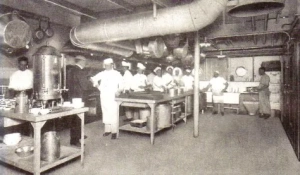
Cook and kitchen staff of the S.S. SOUTH AMERICAN. Image courtesy of the Library of Congress.
The pantry personnel was a mixture of college students, career steward’s department employees, and those who might be called the upwardly mobile.
Most of the college students – the waitresses, busboys, and some of the cooks – contented themselves with doing the same job all summer, either because they liked the job well enough or because the knew that in a month of two they would be back in school. Other students would put in a week or two behind the dish machine then find their way into some quieter, dryer place that paid about the same – $234 a month. After a week or two in the pantry they tended to look upon a job like assistant butcher or lobby porter as *absolutely glamorous. And anything on the upper decks had the appeal of air, sunlight, an occasional glimpse through a gangway, possibly even a tip.
These college students must have seemed a passing parade to the career steward’s department employees. One of the dishwashers had been working down in the pantry for seventeen years. What’s more, this 17-year man had remained at the bottom of the pecking order all the while, and most of the time looked the -part. His white hair poked up in startled tufts, his big shoulders drooped in a limp T-shirt, his watery eyes seemed always fixed on a waist-high stainless steel counter whether he was in the pantry of not. I think he must have lived for his forays into Detroit because each eight days he underwent a wonderful metamorphosis. The first time I saw him in his shore state I couldn’t believe I was seeing the same person. He stood tall in a double-breasted suit that was twenty years out of fashion but clean as payday currency. He spoke with ease and self-confidence, his face shadowed by the downturned brim of his hat. Just where he went and what he did in Detroit no one seemed to know, but when the time came to shove off for Montreal again he was back to usual steamy, crestfallen look.
Almost as dramatic were the promotions of the upwardly mobile. Qualifications would surface after these people had paid their dues in the pantry. My friend Frank, who came aboard as a dishwasher about the same time I did, had radio experience. After a trip or two he took a radiotelephone test in Detroit and made a jump from pantry to radio room. I remember very well the first time I heard his voice going out across the South: “All aboard that’s going aboard, all ashore that’s going ashore, the steamship South American sails for Montreal in fifteen minutes!” Not long before that, a busboy had spoken up and, by virtue of a degree in business administration, had made the jump to the purser’s office. It did not surprise me to learn that Captain Testyon had begun with the company as head linen man.
After two trips to Montreal I moved up a deck to the tearoom. Perhaps because it had not served tea for years, the tearoom was also known as the fountainroom. It looked across a breezy part of the stem studded with round tables fox two. In the tearoom, two ladies and I sold soft drinks, coffee, a few flavors of ice cream, candy bars, and post cards. First thing in the morning I carried up trays of cinnamon rolls from the galley. We went through several trays in rapid order. The empties I had to take down to the potwasher.
If there was a low man on the job ladder, if there was a job no one wanted, it was potwasher. The potwasher worked alone, bent over a deep sink, 56 hours a week, trying to scour the leathery residue from the same pots and skillets he must have washed a thousand times. His job was thankless, and I think he had been at it for several years. Never did he receive me cordially when I slipped in with two or three trays barnacled with sugar. Each time I came in he greeted me with the series of short words telling me not to come back. Each time I stole in more quietly. I regretted not being able to get along with him until my tea- room predecessor told be of the time the potwasher had chased him around the galley with a butcher knife. One night while I was loafing in a gangway watching the New York shoreline drift by, the potwasher grabbed me from behind and started to throw me overboard. Just joking, I think.
When we weren’t working, we were likely to be in our quarters or on the poop deck. The place where the waitresses and other female staff lived was called the harem. It was forward, as were the quarters for the able-bodied seamen. Most of the men in the steward’s department lived aft below the water line or adjacent to a room called the flicker. There were a dozen or so of us bunked right in the flicker, others in smaller rooms along the side. The flicker was sort of a focal point of these quarters since it had the most open space, enough for a table that saw some pretty high-powered nickel-and-dime poker games. It was just aft of the engine room and a deck below. The light in the flicker was, appropriately, a dim yellow. And the rhythmic push and shove of the engines made it a good place for sleeping, except when various pranksters were raising a commotion.
Because it was set aside as a recreational area for the crew, the poop deck could be noisy, too. In fact, one night word came from the bridge that the pilot couldn’t concentrate because the off-duty crew was being so boisterous. The poop deck was two decks above the tearoom, with the glassed-in ballroom in between. Dominating it was a large orange wooden life raft that served as a perch and provided about the best view aboard the South. By day you could get a good look at the Thousand Islands, including the tragically incomplete Boldt Castle; or various bridges which the mast seemed to scrape, though we passed under with ten yards or more to spare. You could watch the dropping or rising of locking through and wave back at the people along the way.
You had a front row seat when we glided past the pavilions of Expo 67. Once on Lake St. Clair, when we were surrounded by members of the Grosse Point Yacht Club, I heard four short blasts of the whistle and saw a large sailboat cross our bow. We found our later that only reversing engines had avoided a collision.
Night sights could be striking. In the middle of a lake on a dark night you could lose the horizon, and occasionally a freighter would float by, hardly more than a skeleton of running lights, her expanding wake the only sign of her passage. Bundle in the chilly wind long enough and you could make out the green glow of the northern lights.
At least once during each trip the crew put on a talent show for the passengers. These evening entertainments were a tradition that went back at least as far as my parents’ days on the South. An area at the top of the main stairway served as a stage. Most of the shows are justly forgotten, but I remember one felicitous moment when one of the pursers was singing “Edelweiss” as we moved through rough water. For a few measures the South swayed from side to side, keeping time with the song.
Hazy in the background was the 1936 law against wooden decks, passed when the South had already been on the Lakes for 22 years. The South had been grandfathered in, but after another thirty years, the exemption had worn thin. We had little awareness that her time was limited, that we were a part of something irreplaceable that was about to pass from the Lakes forever.
When the season ended in October the South’s fortunes fell quickly. Her sister ship, the North American, had been sold to the Seafarer’s International Union and was under tow from Erie, Pennsylvania. to Norfolk, Virginia, when she suddenly and mysteriously sank in 216 feet of water off Nantucket Island with her towline still intact. The South was her stand-in for $111,111.11 – about a sixth of what it had cost to build her in 1913-14. She made the trip from Quebec eventually to a South Camden, New Jersey, scrapyard. Her original owners, the Chicago, Duluth, and Georgian Bay Transit Company, dissolved for lack of another vessel to do the Lakes run. The long slide toward the scrapper was not without precedent among their steamships: The Alabama, stately sister of the North and South, had sat in Holland, Michigan, for 14 years – from 1946 to 1960 – before she was converted to a scow.
But forlorn as the South looks now, with a sad starboard list and rust spreading across her hull, she has come through worse days. In the early morning hours of September 9th, 1924, after she had drydocked in Holland, a fire started amidships near the engine room, where it reached 560 gallons of fuel oil. The resulting explosions blew gaping holes in her hull and gutted the ship. But just nine months later she was back on the Lakes again, better than new.
At the end of her second life, the South’s price dropped to $16,000 before she was bought by Bob Carr of the Mackinac Island-Petoskey area. His plan to make a floating hotel/restaurant of her shifted from Mackinac Island to Menomenee, Michigan, and he continues to look for a worthwhile port for her. He told me recently that he wants to make the South a “living museum where people can walk on it, eat on it, sleep on it, dance on it, and romance on it.” Carr says the South is in fine condition for restoration.
She was able to come back a second time, in 1924, because enough people wanted her back. And while it’s unlikely that the last of the Great Lakes passenger steamers will ever sail again, a graceful and useful return to some lake port might be altogether fitting and proper. As for her present owner, with his plan to bring her back a third time, I wish him well.
Read More of Inland Seas Online

