
MOVING AND LOSING LOCOMOTIVES — Spring 1996

~
The Great Lakes… 84% of the continent’s fresh water… a different story in every drop.
Author: John Hoxland White, Jr.
The first public railroads appeared on the United States east coast in 1830 but the sparsely settled midwestern states were not far behind in adopting this innovation in steam transportation. Kentucky’s Lexington and Ohio Railroad was a pioneer effort west of the Alleghany when it opened in August 1832.1 Within a few years rail lines appeared in Michigan, Ohio and Indiana. Not too much mileage was completed when the financial panic of 1837 all but terminated rail construction in the region. The effects of the panic slowly subsided and by the late 1840s boom times for railroad construction had returned.
Author John White, Jr., was chairman of the Department of Industries at the Smithsonian Institution and later senior historian. His American Railroad Passenger Car was nominated for the National Book Award. He has published nine books and was a Fellow at London’s Science Museum.
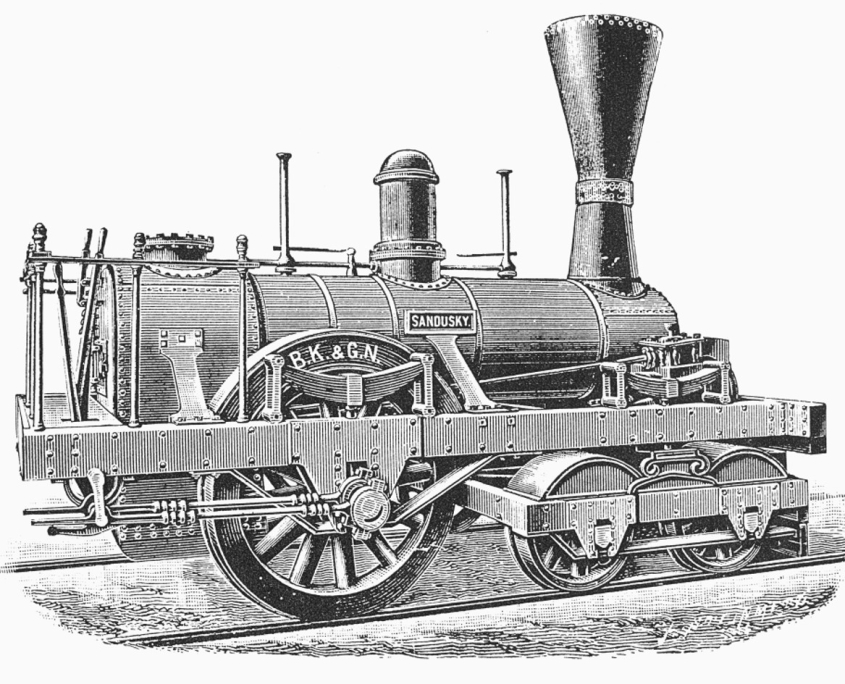
The Sandusky shipped to Ohio’s Mad River and Lake Erie Railroad Aboard the Vessel Sandusky
Despite ample shipping available on major rivers and the Great Lakes, many cities were not on navigable waters. In addition, lakes, rivers and canals froze in the winter. Railroads offered a flexible, all season path for commerce. As the frenzy for more rail lines grew, it appeared that the countryside would soon be blanketed with an iron cobweb. In 1850 for example, Ohio had 575 miles of railroad;2 by 1900, it possessed 2,371 miles.
Railroad building required immense amounts of material. Lumber for trestles, cross ties, and buildings was available locally; rails, locomotives and to a lesser degree, cars, had to be imported. For a typical railroad of the period, each mile of railroad required about 70 tons of rail.3 Most of the rail came from Great Britain – even U.S. mills were unable to compete with them on price.
How to Get the Locomotive to the Customer
Locomotives were made largely in the northeastern United States industrial belt, though a few engines were built in the Midwest. Cars were produced by a mix of local and outside suppliers. There are no exact numbers; statistically, American railroads before 1880 were poorly recorded. But it is safe to conclude that a large traffic in materials, particularly rail and locomotive engines, was conducted from east to west in the 1840s and 1850s. That most of these shipments proceeded to their destinations without incident is another assumption supported, at least in part, by the large amount of railroad mileage completed at the time.
Just a few examples of successful shipments: Chicago’s pioneer rail line’s (the Galena and Chicago Union) first locomotive, two cars and 100 tons of strap rail arrived aboard the brig Buffalo on October 18, 18484 The ship had loaded the secondhand equipment in Buffalo and so involved a long journey through lakes Erie, Huron and Michigan – a trip of approximately 1,000 miles.
A somewhat shorter lake trip was made in 1837 by Ohio’s locomotive, the Sandusky. This small six-wheel engine was completed in early October 1837 by Thomas Rogers of Paterson, New Jersey for the Mad River and Lake Erie RR. It was sent over the Erie Canal to Buffalo (presumably it went up the Hudson River by barge) and was sent on a lake schooner also named Sandusky at a cost of $70.5 She arrived on Nov. 10,1837.
By Land or By Sea or Both
In the correspondence of M.W. Baldwin (preserved at the Historical Society of Pennsylvania) is a letter dated March 12, 1845, between the Philadelphia locomotive builder and the Little Miami Railroad in Cincinnati.
The builder suggested a direct routing over the Pennsylvania State Works between Philadelphia and Pittsburgh which involved two short rail segments – most of the trip was by canal. The two 0-6-0 locomotives weighed only 15 tons each – within the capacity of canal boats of the period. The rate over the Public Works was $1.50 per 100 pounds or $450 each.
By riverboat, the charge per 100 pounds was only 35 cents or $105 from Pittsburgh to Cincinnati – even cheaper if the river was high and navigation was running at full throttle. Baldwin did explain that the boiler would have to be shipped separately from the cylinders and frame. However, via ocean going vessel, it could go as a single unit to New Orleans, then transhipped by riverboat north to Cincinnati. No cost figures were offered but it would appear that the longer route and higher insurance costs would make the sea journey almost as costly as the overland route. However, the 1846 L.M. RR annual report stated that two new but otherwise unidentified engines were on the way via New Orleans or the ocean-river route. It might be noted that the line’s first engine, the Gou. Morrow, had come the same way in 1841 and so the railroad may have decided on this longer but proven routing. Sending locomotives up the river was often a necessity before America’s rail network was connected into the system.
New Jersey’s premier engine, the John Bull, after a lengthy sea voyage from England, was deposited at the Chestnut Street Wharf in Philadelphia in late August of 1831.6 The partially disassembled engine was then piled aboard a sloop which took it up the Delaware River to Bordertown, New Jersey. This historic locomotive, one of some 120 exported to the United States from England during the pioneer period of American railroading, is now one of the Smithsonian’s prize possessions.
Long after the infant stage of railroading, locomotives were water borne for at least part of their journey from builders’ shop to home rails. In the autumn of 1854 the Ohio and Mississippi Railroad received its first engine, the No. 5 for its eastern division.7 The six-foot gauge machine was trucked down to the Cincinnati public landing from Niles & Company’s machine shop to a barge on the Ohio River. A steamer took the barge in tow to Lawrenceburg, Indiana, just 25 miles down river where the whole town turned out to witness twenty oxen haul the engine up the levee over a temporary track to the site of the main line.
Among other locomotives delivered by river barges was St. Paul’s first railway engine, the William. The Crooks and sister engine (named the Edmund Rice) were sent in separate barges from Paterson, New Jersey, west via Chicago to Prairie du Chien, Wisconsin. The steamer Alhambra towed the barges up river 229 miles in 60 hours. As she neared the landing, the steamer’s crew rang her roof bell and set her whistle to screeching to alert the citizens of St. Paul that a most unusual cargo had just arrived.
In 1851 Charles R. Peddle (1820-1893) escorted two locomotives from Taunton, Massachusetts, for the newly organized Haute and Indianapolis RR.9 It was a slow-moving odyssey troubled by many delays and hardships. This trip began fairly well. The engines went by rail from Boston to Buffalo in only four days. Inching the reluctant pair through the muddy streets of Buffalo to dockside and then aboard a brig required nearly ten days.
Once underway a fearsome gale developed, and the ship was battered for a week before reaching Toledo. Peddle was very seasick most of the time and was hardly ready for the challenge of transferring his iron horses from the pitching deck of the brig to a canal boat. This transfer required six days. The Wabash and Erie Canal, however, offered a leisurely and smooth mode of transit to Terre Haute. After seven weeks of frustration and back-breaking work, the engines were delivered.
The earliest locomotives to reach California on sailing vessels went the long route around Cape Horn.10 We assume most of the engines traveled as deck cargo – because they were either too large to go below decks or because dockside equipment to load or unload was not available. Over 150 locomotives were shipped to California over this 14,000-mile sea route before May 1869 when the Transcontinental Railroad opened.
The Non-Network Railroad
Why water transport? Why not simply set the engines on a track to run or tow them to their destruction? The primary reason was the incompleteness of the midwest railway system before about 1855. The network was not constructed in a neat, orderly fashion. There was no master plan . . . no authority to regulate when or where lines were laid down. Railroads were built because some private promoter raised the money and pushed the project.
It was more than free enterprise unleashed; there were also public authorities, especially city and state governments, which built rail roads to bolster the local economy. The State of Massachusetts, for example, built an expensive and lengthy line across the Berkshire mountain range between 1837 and 1841. Many of these pioneering enterprises were built more as portage than intended segments of a national rail system. The Baltimore and Ohio was built to connect the port of Baltimore with the Ohio River, while the Erie was intended to tie the port of New York to Lake Erie.
Even when two major railroads entered the same town their tracks might be separated by several miles. It was difficult and costly enough to transship normal cargos between rail heads across town, without the need to handle full-size locomotives as so much hand luggage.
The Unbridged Rivers
Even when tracks of rival lines were joined, through trips were not possible because of the lack of bridges. Big bridges cost big money and many rail lines made do with ferries at major river crossings. Not all of these ferries were equipped to move cars so the breaking of bulk was more laborious and costly than most shippers cared to reckon. Finally, in 1865 a railway bridge crossed the Ohio; the next year, a railway bridge opened at Albany; many others were bridged in rapid order. Some major rail river crossings remained unbridged for decades – the Illinois Central, the nation’s major north-south line, did not have a bridge at Cairo until 1889.
Misfits
Added to these problems was track gauge difference – America’s pioneer railroads seemed to take perverse pleasure in selecting non conforming gauges.
The Erie Railway, obvious route for westbound engines, was the great broad gauge route – six feet between the rails – while most of the midwestern lines were Ohio (gauge 4’1”’) or standard gauge (4’ 8 ½”). The Pennsylvania, another major east-west trunk line, was an unexplainable 4’9”. The New York Central was a house divided against itself. The main eastern segment across northern New York state was standard gauge (4’8 ½’‘), but its primary western connection, the Lake Shore Line, was 4’9 ½’’ across Ohio and then returned to standard gauge from Toledo to Chicago.
While you could not make an Ohio gauge (4’10’’) engine travel over broad gauge or standard gauge trackage, you could get around it by using special carrying trucks introduced in 1852 by William Kasson of Buffalo. The locomotive was partially stripped down (basically dewheeled which meant the leading trucks, driving wheels, smokestacks and some other parts were placed in regular boxcars). The carcasses of engines were mounted upon heavy-duty trucks and the locomotive was in effect connected into a car. The plan worked well enough, but it was expensive.ll A breakdown of costs was published in the September 17, 1853 (p. 602), American Railroad Journal for moving one standard gauge engine from Cleveland to Chicago.
Lake transit between Buffalo and Cleveland was $112.50.
Towing over Cleveland, Columbus and Cincinnati road, 24 miles, and Toledo, Norwalk and Cleveland road, 89 miles; on trucks, 113 miles, at 35 cents $39.55
Ferriage over Maumee river: 14.00
Moving to and from track and boat: 16.00
Towing over Southern Michigan and Northern Indiana road on its own wheels, 243 miles, at 25 cents 60.75
Forwarder’s commission: 25.00
Time and expenses of Man, 6 days: 21.00
Changing drivers: 6.00
Freight on ponies back to Cleveland: 7.00
Use of trucks and ponies: 5.00
Total for 356 miles ………………………………………. $190.30
Through shipments from Albany should have been possible except for the different track gauges and some rowdy folks in Erie who tore up the tracks near the city. This protest against bypassing Erie as a terminal point disrupted traffic and encouraged locomotive shipments by lake vessels from Buffalo and Dunkirk. An engine could go on Erie RR from Piermont, New York, just above New York City to Dunkirk all on one gauge. Both Buffalo and Dunkirk were busy lake ports and many ships were ready to sail forth to Cleveland, Toledo, Chicago or just about any other lake destination.
RR Sinkings
Thus far we have spoken about those engines which completed their journey by lake or river. A majority of them made it, but a few were lost.
In 1851 it was noted fourteen engines were lost in lakes during the rough weather months.14 Their value was figured at $112,000. Some individual accounts appeared in the press as well. The Buffalo Morning Express September 16, 1851, mentions the brig S.B. Ruggles coming up from Buffalo just off of Ashtabula, Ohio, lost a locomotive mounted on the deck crossways. The engine bound for the Lake Shore Road (Cleveland, Painesville and Ashtabula RR) broke loose from its fastenings when the Ruggles gave a heavy lurch and went through the bulwarks into Lake Erie where it presumably rests to this day. The tender was saved. Just a month later, the Ruggles was once again en route to Cleveland with a locomotive and tender on deck when wind shift forced her to put back after only 30 miles. As waves swelled, locomotive and tender went over the side; the Ruggles was forced against pilings of the Erie basin and sank.
The History of the Great Lakes, Volume I, page 665 notes cryptically that the brig Clarion lost two locomotives off her deck valued at $16,000 in 1851. In his book Ship Wrecks of the Straits of Mackinac, Charles Feltner says the Clarion, while en route to Chicago, lost two locomotives during a storm near Grand River on Lake Michigan. The Greenville and Miami RR noted the loss of two large engines in Lake Erie insured for $7,500 each around October of 1851.15 The Cincinnati Gazette December 4, 1851, mentioned that two locomotives en route from Dunkirk, New York, for the Dayton and Western were lost in Lake Erie – confirmed some days later in the American Railroad Journal.16 This New York trade journal also reported two other engines believed bound for the Mad River and Lake Erie RR at San dusky had also been lost somewhere en route. These accounts are surely only a sampling of the losses encountered on the lakes. It is not difficult to imagine the readiness of any captain in a storm to dump an engine to save the ship.
From an historic preservation viewpoint, the value of finding one of these virgin specimens would be incalculable. Think of a locomotive that has not been changed, altered or rebuilt six dozen times during its service life. Think of finding an untouched specimen direct from the maker’s shop, as built. No preserved engines from this period – and there are precious few at all – have survived in anything like the original condition. Many are so altered that they are nearly worthless as historic documents. While I suspect the state of preservation for an engine dumped into one of the lakes would be less than perfect, it could dramatically advance our understanding of locomotive construction during this period. Anyone having site information on the subject is urged to contact the Division of the History of Technology, Transportation Collections, Smithsonian Institution, Washington, DC 20560. For more information on the appearance, size and construction of nineteenth century locomotives – American Locomotives 1830-1880, J.H. White, Jr., Johns Hopkins University Press, 1968 – reprinted in 1979 by Dover Publications.
NOTES
- Register: Kentucky State Historical Society, Jan. 1933, pp. 9-28.
- John F. Stover, Zron Road to the West, Columbia University Press, New York 1978, p. 116. 3. Albert Fishlow, American Railroads and the Transformation of the Antebellum Economy, pp. 365, 417,419 and 422.
- “The Pioneer, Chicago’s First Locomotive” (Pamphlet) Chicago Historical Society 1976, p. 14. 5. William E. and Ophia D. Smith, A Buckeye Titan, Cincinnati 1953, p. 351.
- J.H. White, The John Bull: 150 Years a Locomotive, Washington, DC, 1981, p. 22. 7. Railway Age, Feb. 8, 1895, p. 66.
- Railway & Locomotive Historical Society, Bulletin 107, Oct. 1962, p. 13.
- Mutual Magazine, June 1948, pp. 19-20. This short article on Peddle’s career is based on contemporary letters between Peddle and the President of T. & I. RR, Chauncey Rose.
- Gerald M. Best, Zron Horses to Promontory, San Marino, CA 1969, p. 13. The Central Pacific engine Gou. Stanford left New York June 1, 1863, and reached San Francisco 112 days later at a cost of $2,282.
- American Railroad Journal, July 30, 1853, p. 487 (hereafter A.R.R.J.). Ibid., Sept. 17, 1853, p. 602 and Nov. 5, 1853, p. 719.
- Deleted.
- Deleted.
- American Railroad Journal, Nov. 5, 1853, p. 719.
- Ibid., Feb. 14, 1852, p. 103.
- Ibid., Dec. 20, 1851, p. 808.
Read More of Inland Seas Online

