
A Rare Description of the Operations of Canadian Lighthouse Lens & Fog Systems on the Great Lakes Before Automation — Summer 1993

~
The Great Lakes… 84% of the continent’s fresh water… a different story in every drop.
In reading the article “John Brown’s Tower End of An Era” by Helene Weaver in INLAND SEAs® Volume 40 Number 3 Fall 1992, I thought it might be a good idea to explain what they were like before automation.

A man leans against the rail of the widow’s walk of a lighthouse. The widow’s walk is a narrow platform that encircles the cupola of the lighthouse.
Caribou Island light station is situated near the middle of Lake Superior 47 29 23 Latitude N 85 49 32 Longitude W. The light was built in 1896, nineteen years after the Confederation of Canada so cannot be classed as one of John Brown’s towers. However, the lens and clockworks that turned the lens were much the same as the confederation light. The tower itself was built of cement with flying buttresses 80 feet high from base to vane and flashed a white light every 30 seconds.
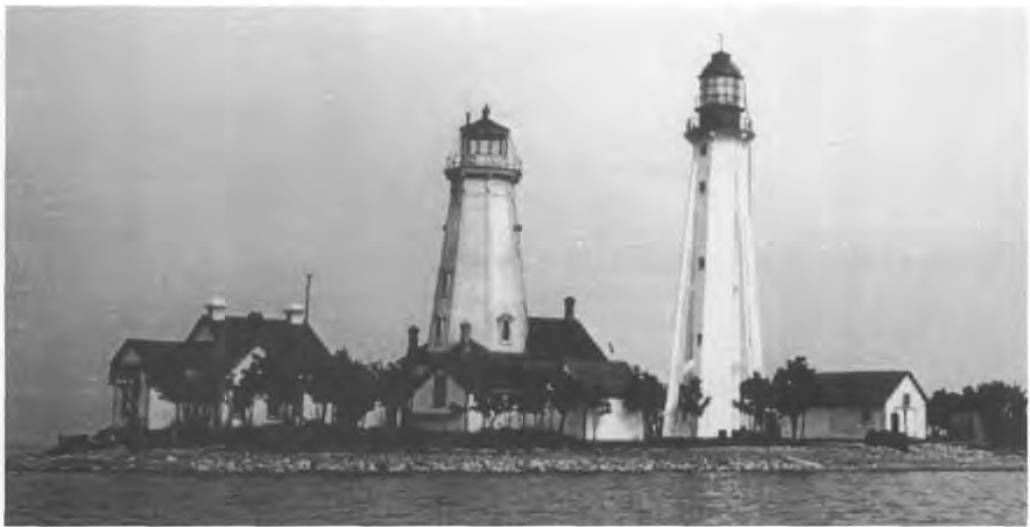
Caribou Island Lighthouse
The lens in these towers always amazed me, particularly the workmanship that went in to building them in those early days. The lenses were so big that a person could walk inside them with no trouble. Each of the prisms was fairly large, about eight inches vertical and ten to twelve inches horizontal. The prisms were placed together in larger panels and bound with brass. These panels were then placed together forming the large lens.
To get the timed flash, large bull’s eye lenses were built around the main lens at proper intervals to time the flash. The entire lens revolved in a circular trough built like a donut. This trough was filled with mercury and the lens floated in it. There was very little friction in this system and when the lens was stationary a person could start it revolving with a slight touch of a finger.
The light itself was a Vapor Type with a large mantle much like the modern Coleman lantern. It burned on kerosene under compressed air pumped into the air tank every four of five hours with a foot pump, the same type used on the old automobiles. The mantle was made of silk and was either 35mm or 50mm depending on the importance of the light station. Some of the stations had two tanks, one for the air and the other for the kerosene. Some of the other light stations used a single tank for the air and kerosene.
The clockwork that turned the lens was much the same principle as the old grandfather clocks with large weights running with multiple cables through holes in the different floor levels. When the weights
reached near the bottom of the tower they were cranked up by hand to a new operating position by the keeper or his helper.
The foghorn was a Diaphone type operating on compressed air. It had a large diaphragm vibrating to give the blast. This horn was of a low pitch and sounded like a cow bawling and could be heard for miles. The engines that ran the compressors were large industrial one-cylinder engines with two large flywheels. What was used in the early days I do not know.
Since the light stations have been automated, Caribou Island being so far from the nearest land, they have not yet figured a way to keep the light going with hydro power. So at this time the light is probably a small battery operated light with a 200mm lens with the battery being charged in daylight with a solar panel. The solar panel also powers the fog horn and other things that require very little current. The fog horn is automatic working on an infra-red principle by bouncing the rays off of the fog to start the horn blowing.
Cove Island light station was built before confederation in 1859 bythe British Government so could be called a John Brown tower. It is situated on Cove Island at the entrance to Georgian Bay from Lake Huron 4519 40 Latitude N. 81 44 9 Longitude with a white flash bright 10 seconds eclipsed 15 seconds. The light before automation was vapor mantle type running on compressed air and kerosene with one tank for air and the other for kerosene. The air tank was pumped up with a foot pump and would last for four to five hours before pumping again. The clock work was the same as all other revolving lights on the lakes.
The tower was built of limestone; it is 85 feet from the base to the vane. At the base where the door goes in, the wall is about six feet thick. It is like passing through a tunnel when going in.
Since automation there is an underwater Hydro cable going to the light from the mainland and there are diesel generators on standby at the light that come on automatically when there is a Hydro failure. The light now has a high-power, mercury-vapor lamp behind the lens. It also has an infra-red operated fog horn.
Chantery Island 44 29 23 N. Latitude 81 24 9 W. Longitude near Southampton, Ontario built in 1859 by the British Government is another of John Brown’s towers. It also is built of limestone and is 88 feet from base to vane. The lens was built in Germany in the early1800’s. In the late 1950’s it was removed by the foreman and I. We went to Southampton by car and to the light station by outboard. This lens was a fixed lens and did not turn. We had to use a stepladder to get to the top of it inside and we took it apart in thirteen sections. It was about seven feet high and six feet in diameter. When we had it all apart we lowered it by block and tackle to the base of the tower. As it was too heavy for us to handle with a small boat we left it at the base of the tower for one of the Department’s ships to pick up at a later date. When at the light we installed a battery operated light in a fourth order lens which caused a lot of kicking by the local fishermen as they said it was not bright enough. Another pre-confederation light was at Nottawasaga Island 443232.
Latitude 80 215 59 W. Longitude near Collingwood, Ontario. It was a revolving light with a white vapor type light flashing every 19 seconds. This light was converted to an acetylene light using mantles that automatically changed when one mantle was damaged. It is not a battery operated light.
On all these lights that were automated there is a lot of vandalism done. At one such as Nottawasaga Island vandals broke down a locked panels and bound with brass. These panels were then placed together forming the large lens.
To get the timed flash, large bull’s eye lenses were built around the main lens at proper intervals to time the flash. The entire lens revolved in a circular trough built like a donut. This trough was filled with mercury and the lens floated in it. There was very little friction in this system and when the lens was stationary a person could start it revolving with a slight touch of a finger.
The light itself was a Vapor Type with a large mantle much like the modern Coleman lantern. It burned on kerosene under compressed air pumped into the air tank every four of five hours with a foot pump, the same type used on the old automobiles. The mantle was made of silk and was either 35mm or 50mm depending on the importance of the light station. Some of the stations had two tanks, one for the air and the other for the kerosene. Some of the other light stations used a single tank for the air and kerosene.
The clockwork that turned the lens was much the same principle as the old grandfather clocks with large weights running with multiple cables through holes in the different floor levels. When the weights
reached near the bottom of the tower they were cranked up by hand to a new operating position by the keeper or his helper.
The foghorn was a Diaphone type operating on compressed air. It had a large diaphragm vibrating to give the blast. This horn was of a low pitch and sounded like a cow bawling and could be heard for miles. The engines that ran the compressors were large industrial one-cylinder engines with two large flywheels. What was used in the early days I do not know.
Since the light stations have been automated, Caribou Island being so far from the nearest land, they have not yet figured a way to keep the light going with hydro power. So at this time the light is probably a small door on the light tower and carried big boulders up to the light platform and threw them down on the Keeper’s Dwelling below putting large holes in the roof. As the dwelling was the original limestone, built at the same time as the tower, it was not replaced but a small shed was built in its place. This type of vandalism happened at many of the old light stations.
About the Author: From 1950 to 1953, Harry T. Crump worked on the lighthouse and buoy ship, C. P. Edwards, for the Canadian Department of Transport (now the Canadian Coast Guard). From 1954 until his retirement in 1975, Crump worked at the Department’s base in Parry Sound Ontario as a light technician, an assignment that brought him in personal contact with many lighthouses.
Read More of Inland Seas Online

