
History of the United States Coast Guard Cutter 𝘌𝘴𝘤𝘢𝘯𝘢𝘣𝘢 — Winter 2001

~
The Great Lakes… 84% of the continent’s fresh water… a different story in every drop.
By Paul E. Petosky
The original Escanaba I was commissioned on November 23, 1932, in Grand Haven, Michigan. The cutter measured 165 feet and was powered by a 1,500 horsepower steam turbine. Stationed in Grand Haven from 1932 until 1940, she was used primarily for icebreaking and search and rescue on the Great Lakes. In 1941, Escanaba I was assigned to Greenland Patrol where she performed escort duty and search and rescue operations. Escanaba I distinguished herself many times, including June 15, 1942, when she rescued 20 people from the SS Cherokee, and on February 3, 1943, when she rescued 132 people from the SS Dorchester. On June 13, 1943, while escorting a convoy to St. John’s, Newfoundland, the Escanaba I blew up and sank within three minutes. With the exception of two men, the entire ship’s company of 100 men was lost. The exact cause of the explosion is not known, although the most probable explanation is that the explosion was caused by a mine or torpedo.
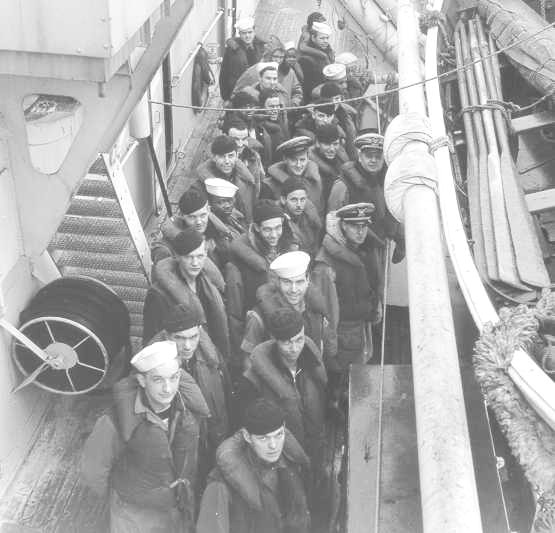
Crew of the Escanaba on deck in 1942. USCG photo.
Escanaba II, commissioned on March 20, 1946, was a 255-foot gunboat powered by a 4,000 horsepower turbo-electric engine. She was homeported in New Bedford, Massachusetts. This cutter performed ocean station patrols, search and rescue and military operations. Escanaba II performed a dramatic rescue at sea on December 27, 1970, saving the lives of 31 crewmembers from the 540-foot Finnish tanker Ragny. The rescue occurred approximately 1,000 miles southeast of Boston in 25-foot seas and earned Escanaba II the Coast Guard Unit Commendation. The cutter was decommissioned June 23, 1973.
SPECIFICATIONS (Escanaba II)
Length overall: 270 feet
Length waterline: 255 feet
Beam: 38 feet
Operating draft: 14.0 feet
Displacement: 1,825 tons
Fuel capacity: 80,000 gallons
Maximum speed: 19.5 knots
Officers: 12
Chief Petty Officers: 8
Enlisted: 78
The third ship to bear the name Escanaba is Coast Guard Cutter (WMEC907) … the seventh of thirteen Famous class cutters built for the United States Coast Guard. Each is named for a cutter prominent in Coast Guard History. Built by the Robert E. Derecktor Shipyard of Middletown, Rhode Island, keel was laid April 1, 1983. Escanaba III was launched February 6, 1985; commissioned “Special,” February 20, 1987; and formally commissioned on August 29, 1987.
Escanaba III has state-of-the-art equipment and is powered by two V-18 ALCO diesel engines delivering 3,750 shaft horsepower each. The Main Propulsion Control and Monitoring System (MPCMS) continuously monitors all vital parameters for the main engines and auxiliary equipment, and can automatically shut down equipment if pre-programmed parameters are exceeded. Escanaba III also has two controllable pitch propellers and two rudders, making for excellent maneuverability. 𝘌𝘴𝘤𝘢𝘯𝘢𝘣𝘢 III’s electrical plant consists of three diesel generators, each capable of providing 450 kilowatts. An onboard evaporator is capable of converting seawater into fresh drinking water at a rate of 6,000 gallons per day. Two shipboard firepumps supply 250 gallons of seawater per minute to firefighting stations throughout the ship.
About the Author
A resident of Munising, Michigan, Paul E. Petosky is one of the Society’s newest members. He is an historian of Upper Peninsula Postal History. He became interested in the history of the U.S.C.G. and related subjects because of his father’s career in the Coast Guard. Mr. Petosky plans to write a book, based on his father’s many photographs and documents from the U.S. Life-Saving Service, which date back to the 1880s and 1890s.
Read More of Inland Seas Online

