
Great Canadian Shipbuilder: Louis Schickluna – Spring 1985

~
The Great Lakes… 84% of the continent’s fresh water… a different story in every drop.
By Richard F. Palmer
It was a recognized mark of great skill for a ship carpenter to hold a billet of wood under his toe and hew a wedge with his adze, using head high strokes. Legend has it that Louis Shickluna could and frequently used a lip adze for hewing his wedges under his toe, at full arm swings.
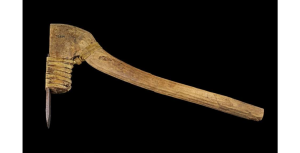 A ship carpenter’s lip adze was the most dangerous of edged tools. The width of its bite between the razor-sharp lips was not much greater than the width of a man’s shoe sole. A shipwright who decided to hew wedges under his toe thusly had to strike true or he would surely shear off his toes or the sole of his foot. Novices were advised against it.
Shickluna, the legendary shipbuilder of St. Catharines, Ontario, Canada, could concisely hew out the finely curved and twisted rabbets of a vessel’s forefoot without using a shaping tool. Without guiding marks he could adze off a caulking seam in perfect bevel the length of a 50-foot plank and leave no tool marks.
For 58 years he built barquentines, schooners and steamboats of all shapes and sizes for use on the Great Lakes, which were owned on both sides of the border. He is credited with introducing the bluff-bowed, wall-sided, bulge- quartered type of schooners that eventually were squeezed through the locks of the old Welland Canal with their jib booms cockbilled to allow their entrance to the locks, often with 700 tons of cargo.
During his lifetime Shickluna was a noted marine architect, shipwright, builder, captain, financier, and owner of shipyards and lumber mills. He was born Louis Michael Scicluna at Senglea on the island of Malta on June 16, 1808. His father and grandfather were shipbuilders, consequently he was eventually apprenticed to this craft.
When he was 17, young Louis left Malta and arrived in New York, where he found a shipbuilding job. Within a short time he went to Jamestown, New York, then to Trois Rivieres, Quebec, where he worked as a foreman on construction of the Royal William, the second Canadian steamer to cross the Atlantic. Later, he moved to Oakville where he helped build the 350-ton steamer Constitution, later known as the Transit. This vessel was launched on January 19, 1833. About 1834 he was involved in construction of a dock at Niagara-on-the- Lake.
We next find him at Youngstown on the Niagara River, studying marine drafting and naval architecture.
Records are meager, but it is known he constructed the schooners Two Brothers (1835); Louis Shickluna (1836); and John Porter (1838). Some records state he constructed the R.H Boughton, first schooner to pass through the Welland Canal November 27 to 29, 1829. This vessel was named after a Lewiston, New York businessman. It is possible as his whereabouts at this time is unknown. Shickluna’s eldest son, Henry, was born in Youngstown on July 4, 1836.
On October 26, 1837, the St. Catharines Journal announced that at 10 A.M. on Tuesday, November 21, the shipyard and effects of Russell Armington, deceased, would be sold at public auction. These included a cow, a one-horse wagon and harness, office furniture, a quantity of lumber, bolt iron, cordage, spikes, oakum, a crosscut and two pit saws and a variety of ship wright’s tools.
Armington opened his shipyard in 1827 with substantial financial backing from William Hamilton Merritt, mentor of the first Welland Canal. It was here that the first vessel constructed on the canal ‘was launched on April 24, 1828. Shickluna was the successful low bidder on the shipyard and after reorganizing and provisioning the yard for his purposes he placed the following advertisement in the June 18, 1838 edition of the St. Catharines Journal:
SHIP WRIGHT BUSINESS
The Subscriber begs to acquaint the owners of schooners or other Water Craft that are in the habit of passing through the Welland Canal that he has taken the SHIPYARD at St. Catharines formerly occupied by the late Russell Armington and where he intends following the business of BUILDING and REPAIRING, in all its branches, at the most moderate terms. He will also keep constantly on hand Handspikes, Oars, etc., ready made, for sale. From his being well supplied with Spars & Timber at all times suitable for the business, and having in his employ a number of good workmen, jobs will be done with the utmost despatch. Reference as to character and abilities to Wm. Hamilton Merritt or H. Mittelberger, Esqrs., St. Catharines, or Mr. H.H. Smith, Youngstown.

Image from 1985 Spring issue of Inland Seas.
LOUIS SHICKLUNA
St. Catharines, June 27, 1838.
This advertisement gives some clue as to his tenure at Youngstown, as “H. H. Smith” was Hezekiah H. Smith, a prominent Youngstown businessman and gristmill owner. Several references state: that until 1845 Shickluna leased the shipyard from Merritt for $15 a year. That year he purchased it outright.
One son, Adrian, born there on June 2, 1839, became a priest and later taught at LaSalle Academy in New York, where he died in 1910.
By 1841, Louis Shickluna was building on speculation as well as to order. The yard was located on the first Welland Canal at a location known for years as “Shipman’s Comer.” The dockyard was constantly busy with works of rebuilding, overhauling and repairing. The drydock was divided into two sections which could be flooded or drained separately, and could accommodate two full canal-sized vessels at once. Both sections were almost continuously occupied for years. Often while two vessels were in the dock, two others and sometimes several lay waiting their turns to enter.
A contemporary writer noted Shickluna “has given our famous Town ahoist ahead, a larboard luff, and filled her sails of late . . . he is one of our sheet anchors, main stays, top gallant fellows, flying pennants, keel cutters, wave clippers, storm riders, floating palace builders, and Union Jacks. Perhaps none among us have been more successful than our townsman, Mr. L. Shickluna, the eminent Shipbuilder, who, while shaping the knarled oak and unproductive pine into proportions of beauty and use, has thus, building our vessels, built up a fortune for himself and given greater facilities to the commerce of the country and trade of the Lakes”
Mr. Shickluna’s first known product of the St. Catharines yard was the Chief Justice Robinson, a schooner, which was launched on May 4, 1841. At the time she was the largest vessel able to navigate the first Welland Canal. This was followed by the schooner Merchant Miller, launched on August 18, 1841. The two-masted schooner Lady Bigot was launched on March 17, 1842. This was Shickluna’s first oceangoing vessel.
On this occasion the builder was presented with an embroidered green and white silk banner with the red cross of St. George in one comer and a large harp entwined with a shamrock, rose and thistle, all in gold leaf. It was presented by the inhabitants of St. Catharines.
Five Ships Per ‘Year
By the mid-1850s Shickluna was turning out about. five vessels a year, plus numerous repair and rebuilding jobs. The prosperity of St. Catharines itself was closely linked with that of Shickluna’s yard, giving employment to hundreds. At its peak, in 1871 the yard stretched more than a half mile along the canal, con- sisting of two blacksmiths’ shops, a planning mill, joiner’s shop, rigging loft, two storehouses, a spar yard, lumber yard, offices and a small boat factory. In 1850, due to increased business Shickluna opened a drydock beside Lock 3 of the second Welland Canal. This dock was limited to the repair of canal-
An example of the speed with which Shickluna could repair a ship occurred on August 26, 1858. According to the St. Catharines Journal, the schooner W.F. Allen, in need of a new mast, docked at the yard that morning and by evening was again seaworthy.
Accounts vary on the number of ships actually produced by Shickluna. A few more than 100 schooners and steam propellers appear to have been built from scratch. Numerous other barges, scows, tugs, a yacht were constructed and many ships rebuilt.
In 1853 Shickluna leased the Niagara Drydock Company in Niagara. Here he built the steamers Canada and America in 1853-54 for the Great Western Railway. A 1,000-horsepower steam engine was installed in both of them. At the time they were the largest on Lake Ontario. However, they proved a poor investment as railroads rendered them obsolete. About 1858 they were sold and taken down the St. Lawrence River to Montreal, where they were again sold. The new owners, interested in the Cariboo gold rush, intended to take them around Cape Horn to California and place them on the San Fran- cisco – Fraser River run. However, this did not materialize. They were lost in the Atlantic Ocean in 1862 while in U.S. Government service during the Civil War. He built at least three other ships at Niagara and one at Niagara
Drydock’s Chippewa yard, between 1853 and 1856, when he surrendered his lease. During the 1860s the yards employed 250 men, including some slaves who escaped from the United States. Shickluna had a phenomenal memory for detail. In a few seconds he could give a very accurate estimate on a ship con- tract. His investment in shipyards was estimated at about $4 million. Many streets in St. Catharines were named after members of his family. Some of his ships have been featured in Canadian folk songs and there are many islands on the upper lakes named after his ships.
In the fall of 1856, Shickluna sold his shipyard to Donaldson & Andrews for $60,000, intending to retire. However, he changed his mind and re-acquired it in December, 1857, for the same price. Donaldson & Andrews built one ship there, the R. H Rae, launched on October 5,1857. Otherwise, their work was confined to repairing ships.
Shickluna again leased the Niagara drydock in 1863-64 to build the steamer City of Toronto, launched on April 20, 1864. She replaced the steamer Zimmerman which had been destroyed by fire. For several years she was on the Toronto – Niagara run. Zimmerman was destroyed by fire while at the Muir Brothers shipyard at Port Dalhousie on October 31, 1883.
Did Not Read Nor Write
Throughout his life, it is said Shickluna could neither read nor write English. Contracts were made verbally and sealed with a handshake. Records
of materials, costs, lists of employees, wages and similar items were the only documents kept.
Everything he built, however, was of the highest quality. In the beginning he built ships of good Canadian hardwood, fastened with iron and copper. In later years he became well known for his composite (metal and wood) hulls. Shickluna reached the highest evolution of the wooden sailing vessel in the last decade of his life, between 1870 and 1880.
He left for his second and last visit to his native Malta in May 1871. The event was marked by speech making and music. He was presented with a Scroll of Honour by the citizens of St. Catharines. The 97 signatures included most of the prominent people of the community. He was on familiar terms with many
politicians and notables of Ontario and was frequently honored at St. Lawrence City Hall in Toronto.
Louis Shickluna died April 24, 1880.
Last remnant of this once-prosperous business was the hull of the Sir John Napier which lay abandoned there until everything was filled in in the 1950s. For a century Shickluna was forgotten and uncommemorated. Through the efforts of C. A. Caruana of Toronto, a retired teacher and historian, and others, Louis Shickluna has been placed in his rightful and proper historical perspective. On November 29, 1979, a plaque was unveiled in. St. Catherines, near the site of the old shipyards.
Bibliography
Articles about Lewis Shickluna appearing in Maltese Forum, Spring and Summer, 1980 issues, by C. A. Caruana, Ivan Magri-Overend and Donald C. Holmes.
“St. Catharines A To Z”, by “Junius,” 1856, Series of articles published in the St. Catharines Journal.
Republished by St. Catharines and Lincoln Historical Society.
Articles about Shickluna in “Schooner Days” articles by C. H. J. Snider, Toronto Telegram (Numbers “CI” and “DCCCVIII”).
“The Shickluna Story” by Peter D. A. Warwick, June/July 1978 issue, Canadian Geographical
Journal.
Also, materials furnished by the St. Catharines Historical Museum and Mrs. Sheila Wilson, Special Collections, St. Catharines Public Library.
Biography of Hon. William H. Merritt by J. P. Merritt, St. Catharines, 1875.
Oakville and The Sixteen by Hazel C. Holmes, University of Toronto Press (revised edition) 1971.
Read More of Inland Seas Online

