
Scale-Spangled Apron: A Woman’s Commercial Fishery Experience in Grand Haven, Michigan — Fall 1999

~
The Great Lakes… 84% of the continent’s fresh water… a different story in every drop.
Author: Robert C. Grunst
Beverly Van Hall Hudson grew up knowing piano workers: the dampermen and voicers, springers and action men, chippers, finishers and rubbers and tuners. The Van Hall house stood next to the Story & Clark Piano Factory at 119 Columbus Street, Grand Haven, Michigan. Beverly knew the workers by their gaits and postures, by colors of lunch boxes — silver or black — and trace scents of oils and varnish they left behind as they walked past the house. Bev knew them by first names if they stopped.
Jim Van Hall, Bev’s father, was an artisan of a different calling. The men who stopped at the green house often came for fish, and from the mid-1930s through the war years, they witnessed a transformation in Beverly Van Hall.
Bev’s great-grandfather, Adrian Van Hall, had immigrated from the Netherlands, settling at Grand Haven and setting out under sail to fish Lake Michigan in the late 1860s. In 1894, Adrian’s son, John, inherited the fish rig and subsequently acquired the steam tug 𝘝𝘪𝘰𝘭𝘢, fishing the vessel for ten years until his sudden death in 1915. John Van Hall left behind his wife and eight sons and the 𝘝𝘪𝘰𝘭𝘢.
Five of the brothers, including Jim Van Hall, eventually operated their own fish rigs out of Grand Haven. Unlike scents of stains and varnish, they brought to shore the pungent smell of wire grass that washed off sand beaches, soaked in the lake, and kinked up in their nets. They carried to their homes scents of fish ducks. With fish flashing in twine set twelve to sixteen fathoms deep, sometimes the ducks dove for the lures and became entangled in the netting. They carried home scents of the clay, sand, and mud bottoms they fished. And, naturally, they smelled like fish. Born September 7, 1926, Bev Van Hall knew the smells before she knew her own name. Maybe trying to sort the smells out tipped the scales.
Or maybe overhearing the talk captivated her imagination. Father, uncles, and family friends — fishing people mostly — talked about their craft. They talked about marine engines, hooks and nets, about whitefish, herring, and trout, something called lawyers, perch, mooneye chubs, and sticklebacks. They talked about places where they set their nets: “the Gray Sisters,” “French Path,” “Rosy Mound,” “the Flats,” “Scotch Cap.”
One of Bev’s cousins, Arlene, remembers driving with her mother out to Grand Haven’s south beach, Armistice Day, 1940. The wind hammered their old coupe. Spray and sand whistled past on forty-knot straight horizontals. Arlene saw her father, Ray Van Hall, and the boat he’d named after her broach and almost roll over before the wheel and rudder caught; the 𝘈𝘳𝘭𝘦𝘯𝘦 spurted safely into the channel, ascending blue-green swells hemmed in between the walls and dropping out of sight and ascending again. Days later, once everyone had calmed down enough after the narrow scrape, they noticed the car. The coupe’s finish had been sandblasted down to bare metal in places.
Women made — and still make — vital contributors to the Great Lakes’ commercial fisheries. They strung nets, spread nets on the drying reels, picked snarls out of the twine. They packed dry nets for resetting. They ran retail markets, filleted and smoked fish. They kept account books. When the wind blew up and the lake pounded the beach — husbands, sons, and brothers somewhere out beyond the breakers — they worried, just as Arlene Van Hall and her mother before her.
But few women had time or desire to work aboard the fish boats. Wives had children to care for; daughters helped their mothers. Hours aboard the boats were long, the labor punishing, and no one needed instruction upon the lake’s potential for violence. Nevertheless, Bev Van Hall, age 15, started working with her father on the lake the summer of 1942. Bev says, “I liked being with my dad.”
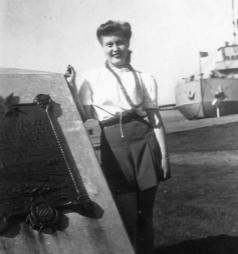
Bev at Escanaba Memorial, Grand Haven’s Coast Guard Park, 1944.
The Beginning
The war was on. Uncle Babe — her dad’s fishing partner — had gone to salt water with the merchant marine. Other uncles had suspended their own fishing operations and gone to work building tank and aircraft engines at Muskegon’s Continental Motors. Experienced fishermen were hard to find, but Bev’s youthful audacity overshadowed her inexperience. Jim Van Hall had an open, 20-foot boat, with a small gasoline motor. Father and daughter fished the boat two handed, motoring to fishing grounds usually within 10 miles of Grand Haven’s red lighthouse.
They fished for whitefish and perch. Jim Van Hall lifted the nets the hard way, pulling hand over hand. Bev worked in her oilskin apron, clearing fish from the nets and boxing. At first, Bev says, she got seasick almost as soon as her father turned off the motor and the boat began pitching and tossing. But focusing on clearing whitefish gills and jaws of cotton twine, getting purchases on the slippery lawyers (fishing people’s familiar name for the freshwater cod), keeping the net’s corks and leads in order, cured her. With the cure came hard-earned confidence and a seasoned perspective upon the meaning of hard work.
After lifting, Bev took the oars, pulling as her father played half a mile’s worth of twine back into the lake. Bev’s hands molded to the oars’ contours, blistered and swelled. But they were together, father and daughter, five miles offshore, off the Twin Sisters perhaps, with fish and seagulls and the easy lull of the lake. Bev saw distance compress beach lines, hills, and trees into odd, light-squashed horizontals and strange swellings, as if the land they came from had been misplaced. On those perfect days, there was no better place to be, Bev says, than on the lake.
In 1943, Jim Van Hall bought a larger boat, a 36-footer with a Universal gasoline motor. Short for former South Haven, Michigan owners, a Dave and a Bob, the 𝘋𝘢-𝘉𝘰 was housed over and had the additional amenity of a steam powered lifting machine, an end to the hand-lifting of nets. Because of meat rationing, fish prices were good during the war.
Customers for fresh and smoked fish who came to the Van Hall door often found Bev Van Hall and her father in their oilskin aprons, cleaning fish in the kitchen. If rough weather prohibited cleaning them on the lake, Bev says, they brought perch nets to the house. They spread a canvas over the kitchen floor. They sat on upturned fish boxes and hauled the nets over their legs, throwing the perch into tubs of ice, readying the twine again for the lake.
Bev fondly recalls working in the comfort of the kitchen, the coffeepot perking, her mother coming and going about her routines. They chewed the fat with whomever dropped in, and for the jokers who’d poke fun at her scale-spangled apron and face, Bev had a practiced, and visual, reply … she used the bent nail of her hook. After collaring twine behind a perch’s gills, she skewed the fish through the eyes with her pick, then twisted and pulled, slicking the perch free of the netting with consummate confidence and skill. That was message enough.
Bev’s mother, Ann Van State Van Hall, born in Jenison, Michigan, moved with her family to Grand Haven, met and married Jim Van Hall. Ann refused direct participation in the kitchen fish picking sessions, and Gwendolyn, Bev’s younger sister, kept as far away from fish as she could. When perch weren’t being picked in the kitchen, Bev and her mother worked together packing nets off the reels behind the house. Ann prepared chubs for smoking. (“You have to spoon the blood veins out.”) Ann prepared the brine, hung the fish, and tended the smokehouse fire. Bev and her mother also strung nets, drawing the “stretch” from hooks turned into a living room wall, through a door, and into the kitchen.
It was a family business and success depended upon each family member’s contributions. The house was the focus of fish trade and culture. Bev remembers eating fried and baked chubs at home. On the lake her father wrapped chubs with onions, pepper, and salt in a layer of waxpaper, then added layers of newspaper, soaking each layer in a bucket of water. He put the “Domer” to steam on the 𝘋𝘢-𝘉𝘰’s little boiler while they lifted nets. “Nothing tasted so good,” Bev says. “My mouth waters just thinking of those domers.”
Bev believes there’s nothing surprising in what she did. “I knew fishing from the beginning. I wanted to learn where you went and what you did out there on the lake. Dad needed me.”
Jim Van Hall and his daughter fished the 𝘋𝘢-𝘉𝘰 with only a compass and a watch to navigate by, with a coil of line hitched onto a sash weight to sound the depths. They worked in rain, fog, on clear days and took their lickings when it blew.
After Babe Van Hall returned from the war and Jim and Babe bought a bigger boat, the 𝘍𝘳𝘦𝘪𝘵𝘢𝘨 𝘉𝘳𝘰𝘴.. Bev steered, set back nets, dressed fish and tended the “𝘍𝘳𝘦𝘪𝘵𝘢𝘨’𝘴” lubricators. “Some days we dressed chubs all the way into the dock from the lake. You brace yourself when the lake is rough. You find your rhythm. You know what the boat will do before it does it. You keep your knife sharp on the steel.” Harry McGill made those knives.
Bev and her dad drove the nine or ten miles to Nunica to deliver perch to Turk’s Tavern on Lakeside in Grand Haven. They lined up the piano factory’s boiler room stack for a range on the perch grounds. The “Gray Sisters” lay to the south, past Sunset Beach.
Talking about the past brought even more details back into focus. Bev recalls how her dad sensed air pressure changes by some uncanny instrument. “I never knew how. I wish I had asked him. He’d just say, ‘Today’s going to be a day we don’t want to be out on that lake.’ ” Then Bev and her dad got in the car and drove out to Moaners’ Hill. Maybe it would be dead calm, just the usual sea rolling . . . “But he’d always be right,” Bev says. “By one-o’clock the Coast Guard’s storm pennants would be flying.”
Moaners’ Hill sits atop the dune south of Grand Haven’s channel. Bev remembers on the worst days all of Grand Haven’s fishing people ended up on the hill, parking in the lot south of the Highland Park Hotel: Bev and Jim Van Hall; Uncles Babe and Ray and George; Gene Hill and Dave Fritz; Dibbin O’Beck, Will Ver Duin, Harold Krause, Corky Fase —
“They all came to pay respect. Sometimes seas broke out all the way, teeth serrating the far horizon. If you did not have your nets in deep water — the deeper the better— you might never see your nets again. If any of the local boats had been caught out on the lake, the best eyes in Grand Haven kept lookout on Moaners’ Hill.”
Beverly Van Hall Hudson is the possessor of exuberant laughter. It comes easily and it lasts. She laughs talking about clearing perch nets in the family kitchen. She laughs when she tells the tale about outwitting the game warden who, it turned out, knew all along he was being outwitted; fishing people were having hard times making ends meet. (The warden “looked the other way.”) And Bev laughs when I ask if the boats had radios. (They didn’t.) Laughter made her feel better when the hard work was finished and her family sat together in the kitchen, the radio tuned to catch Fibber McGee and Molly.
Bev is quick to say this was serious business. “It wasn’t easy work, but once fishing gets in your blood, it stays. I dressed more fish than people could dream. I still have my knife … our scaler in a drawer in the kitchen. I still have the steel. Those are rhythms I’ll never forget.”
Bev and Don
Bev had known Don Hudson most of her life. He had grown up in the house across the street from 119 Columbus. Soon after Don returned from duty in the South Pacific, he and Bev Van Hall were married — August 31, 1946.
Bev continued to help her dad and Uncle Babe ashore and on the lake. Don helped too on weekends off his job with the Pere Marquette Railroad. Children came along, six of them, and on the strength of good sea legs, Bev took to raising a family.
On March 23, 1952, a spring storm blew up, and before the blowing subsided Grand Haven fishermen had lost over $10,000 worth of nets. Over the next two years, lamprey eel decimated lake trout and whitefish populations. Market prices for lake chubs and perch fluctuated wildly while basic operating expenses only climbed. In 1954, Jim and Babe Van Hall made the hard decision to get out of the fish business. They sold the 𝘍𝘳𝘦𝘪𝘵𝘢𝘨 𝘉𝘳𝘰𝘴. and took full-time jobs with Story & Clark. More than one hundred continuous years of Van Hall fishing had come to an end.
Bev missed work aboard the tug, but certainly didn’t lack for work at home. And today you’ve got to drive clear up to Ludington to get a smoked chub still hot out of a smokehouse.
Jim Van Hall died in 1976, the last of eight brothers. “I miss fishing,” Bev says thoughtfully. “I miss my dad.”
Bev’s feeling fit again after having a hip replaced. She was seventy-two years old just last week. Next year she and Don will have been married fifty-four years. Forty-four years have gone past since the 𝘍𝘳𝘦𝘪𝘵𝘢𝘨 𝘉𝘳𝘰𝘴. chugged for the last time out of Grand Haven. When the wind picks up though, Bev and Don still drive out to Moaners’ Hill. “I see us, my dad and me,” she says quietly, “and all the others still up there watching that lake. ‘That’s another five pounds of twine torn to rags!’ someone says when one of the big seas breaks on the farthest bar.”
Time passes. But in Bev Van Hall Hudson there’s still the spirit of an audacious fifteen-year-old with scales on her apron and her face. “It was hard work,” she says smiling, “and nobody got rich. But we had an understanding. The lake takes care of you if you take care with the lake.”
Read More of Inland Seas Online

