
How to Steam a Steamboat: Sailing in Hand-Fired Lake Vessels in the WWII Era | Fall 2004

~
The Great Lakes… 84% of the continent’s fresh water… a different story in every drop.
By William E. (Bill) Bardelmeier
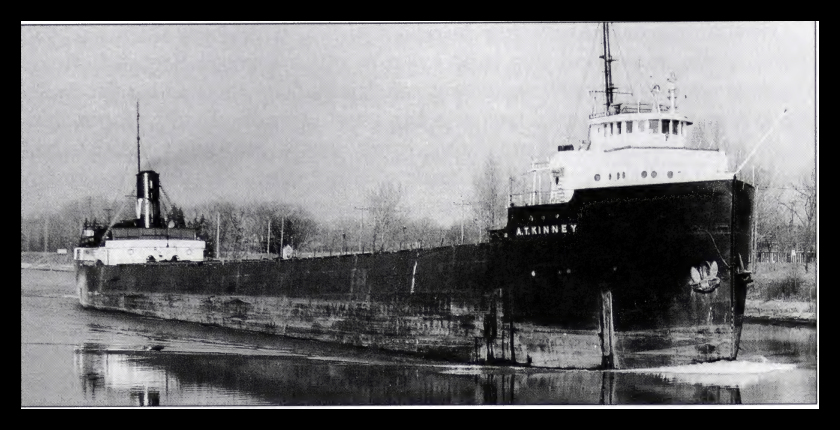
Bill Bardelmeier began the summer of 1943 as a porter on the A. T. Kinney.
During the Korean War, I served with a fine Chief Petty Officer who had more gold braid stretching up his arm than a four star admiral. He started earning all those gold “hash marks” during the infancy of naval aviation. Chief Dauphineous’ specialty was re-covering fabric wings. When President Roosevelt sent the newly re-fitted Old Ironsides around the entire U.S. coastline in the early 1930s to be seen by the school children who had donated the thousands of dimes for the refit, “Dau” was assigned as sailmaker on the USS Constitution.
By the time of the Korean War, Dau was about ready to “drop anchor” for good. When he encountered some young officer or petty officer with an inflated idea of his “seafaring saltiness”, Dau would find an opportune time and place while speaking to a third party (but always well within earshot of his target) … to say “Well, when I sailed in the Constitution, ….we did it this way … or that.” Seldom could anyone top Dau’s sea stories.
I might aspire to emulate old Dau, because there aren’t many experienced hand-fired coal passers and firemen still around today. Having observed the avid enthusiasm and dedication of Great Lakes “boatnerds,” I would like to describe — for the record — the fire room watch that was stood on many Lakers in the first 45 years of the 20th Century.
During my school and college years (1942–1947), I worked summers in all three departments on board Lakers. My career began with a brief stint as a deckhand on the Troy H. Browning in 1942 (Off. No. 86610), when I received my seaman’s papers. I began the summer of 1943 as porter on the A.T. Kinney (Off. No. 204864). However, the Steward shortly promoted me to second cook announcing to the master that he was sick and tired of assistants who “hit the bottle and missed ship.” The master wisely but heatedly objected, “We can’t have schoolboys who will leave in September as second cook!” But the steward was adamant and the captain reluctantly backed down. In addition to being ship’s baker, the second cook cleaned the captain’s stateroom, changed linen and made up his bed. On my final day before debarking in the fall, I “shorted” the sheets on his bunk to show appreciation for his support. Aboard the A.T. Kinney I learned to bake cake and to solo prepare breakfasts for a hungry crew. Stewards were
privileged to sleep-in at breakfast and second cooks with the help of two porters did it all. As a result I kept my hand in at cooking for the next 60 years.
I made a brief trip along with a school chum who had just gotten his papers aboard Myron C. Taylor (Off. No. 228960) and the new John Hulst (Off. No. 237380) as coal passer. We both got back to Lake Erie just as classes resumed.
In 1944, I had worked as coal passer aboard the John Manuel (Off. No. 207448) during a short window after school graduation before reporting to the U.S. Navy officer training program. In 1946, I was discharged form the Navy having crammed three years of college credits into just 24 months! Within two weeks of my Navy discharge, I had a job as coal passer on the Pioneer (Off. No. 203941) John McDermid, Master. That summer (1946), an aggressive drive was launched to organize Lakes sailors into the National Maritime Union. I stayed on and became fireman during the strike. Men were scarce and the steamship companies desperate, so I got paid both salaries as coal passer and as fireman. It was hard work but that fall I went back to college with some money for a change.
In June 1947, I graduated from Yale and applied for and was given a commission in the “regular” Navy. I had 30 days before I was due to report to a destroyer, so I signed on as deckhand on Boland’s old Consumers Power (Off. No. 207361) just to get back on the Lakes. I didn’t reveal my new status as Ensign, 1100, USN.
So while I was coal passer briefly on several Lakers, this paper describes my work on board the Pioneer.
Of the approximately four hundred plus U.S. Lakers sailing in the early 1940s, most had fire tube boilers, often termed Scotch boilers. These were not very efficient heat machines. The feed water for making steam was contained inside a big steel cylinder fitted atop a firebrick lined “firebox.” Numerous, fairly large diameter steel tubes were fitted tightly through the ends of this boiler.
Hot gas from burning coal in the firebox passed through the inside of these large tubes. Heat energy was transferred into the surrounding water which duly became steam. By modern standards, the steam was maintained at a low pressure of about 180 pounds per square inch because the metallurgy early in the century didn’t safely permit higher pressures. As the steam boiled off it was piped aft to a big heavy reciprocating steam engine in the engine room which drove the propeller shaft.
By the early 1940s, new ships were appearing with water tube boilers. As the name implies, the feed water passed through inside many much smaller diameter high grade steel tubes lying above the firebox with the hot burning gases passing outside. These boilers could stand much higher pressures and the steam coming from them was at a much higher temperature. In a few more years it became routine to pass the steam through still another set of tubes placed high in the stream of hot gases where the steam was “superheated” with still more heat energy before it went on to rotate a steam turbine in the engine room.
The fire room, or boiler room, of a coal burning ship was not an attractive space. The licensed engineers — in charge of both the boiler room and the engine room watch — seldom stuck their head in the fire room. It was grimy with coal dust, extremely hot and poorly lit. It was a virtual dungeon. (By comparison, on ships of that era with the old “up and down” reciprocating engines, it was customary to keep all the machinery in the engine room painted in bright colors and spotless.)
During the 1940s, the newer ships already had mechanical stokers and did not require hand-firing of the boilers. The stokers were simply machines that crushed the coal and conveyed it into the firebox. I never served in the engine department of a stoker-fired ship. By the 1950s, even older vessels then in service were retrofitted with stokers.
Typically I recall having two fire tube boilers each with two hinged firebox doors approximately 30 inches wide and 20 inches high. Coal was shoveled through these doors into the firebox.
The ship’s coal supply was contained in a single bunker, or small hold, located immediately forward of the fire room. This was supplied at the Lower Lake ports via rail car dumper which poured perhaps six or eight rail hopper cars to fill the bunker heaping full via a hatch in the forward end of the boat deck. While taking on bunkers, several panels were fitted temporarily below in the fire room to close off large open coal bunker doorways located about ten feet from the firebox doors through which coal from the full bunker could flow outward onto the deck plating. As the coal supply diminished during the voyage, the coal passer would have to walk an increasing number of steps to reach the coal. Ultimately the supply ran low, requiring the coal passer to go inside the coal bunker and shovel coal aft onto the deck plates where his senior partner, the fireman, could easily reach it with his shovel. Normally, the coal passer simply did what was necessary to assure a handy pile on the floor plates where the fireman could scoop it up.
A good fireman wasn’t just a shovel wielder. He became very adept at scooping up just the quantity he wanted, then gracefully arcing it through the firebox door to land precisely where he wanted it in the firebox. With a mere glance, he knew exactly where the bed of burning coal was hot enough and where it needed some sustenance. His shovel barely “dinged” the bottom of the fire door and he knew how to make the instinctive small changes in shovel angle to send coal a bit right or left or to shape a longer or shorter trajectory.
The fireman worked with three basic tools: the large pan shovel, a steel slice bar, and a hoe. The slice bar was about eight feet long comprising a paddle-like flattened end portion about four inches wide and two feet in length before tapering into a round steel shaft about 7/8-inch diameter, ending with a closed loop constituting a protected handgrip.
A healthy fire required that the white-hot bed of burning coal have porosity to allow ample air from large blowers to flow up through to maintain combustion. When the flame bed started to show darker, cooler spots, the fireman would insert the slice bar and ram it back through the flame bed to increase airflow. When working the aft areas of the firebox, the fireman was very close to the open fire door and the heat became daunting. Radiant heat diminishes quickly as distance increases, so the fireman instinctively made a quick retreat. Steam pressure gauges mounted overhead were kept under very close scrutiny. An experienced fireman, however, knew when to start shoveling a few more shovelful into each door every few minutes; virtually continually. Shovel too fast and you’d cool the fire and drop the steam production. Goof off a couple minutes and the same cooling and steam pressure drop would occur. If pressure varied much, the engineer on watch in the engine room would be on the voice tube from the engine control station (who also was watching his own pressure gauge) and would suggest the fireman “get his act together.”
At least once per four-hour watch, the coal passer and fireman had to “clean fires.” Normally this was done just before going off watch because one was obliged to turn over clean, healthy fires to his relieving watch. More frequent cleaning might be required when the ship was supplied a poor-quality coal. This could and did occur because the trade custom was that the coal shipper was entitled to sell the ship its fuel. “Bad” coal caused much grief on board. The chief engineer would be mad as a hornet and sometimes embarrassed before the captain and the head office if it was so bad that full power couldn’t be maintained. But the fireman and coal passer were the ones who really suffered. They might have to clean fires far more frequently and work hard shoveling a large volume of hard-to-burn material to keep up steam pressure.
In the process of “cleaning fires,” the fireman first rammed the slice bar into the centerline of the firebox holding the flattened section vertical. This marked a line along the firebox grate bars dividing the fire roughly into equal parts. During the next few minutes he had to maintain steam flow using only the initially undisturbed half of the firebox while starting to dispose of the other half comprising a lot of poorly burning material with a lot of ash and clinker. He first used the slice bar to “wing over” (flip or toss) the upper part of the burning mass onto the portion temporarily being retained. He then used a large heavy long-handled hoe, not unlike a giant garden hoe, and pulled the hot ash-laden side of the fire out the firebox door flowing into a red-hot pile a few feet in front of his shoes sending the intuitive fireman into a hasty retreat. Since radiant heat is an inverse function of the square of the distance, a few feet sufficed to avoid injury if he moved quickly. The coal passer directed a water hose at the pile, and for a few moments, hot water vapor filled the area like a London fog. The fireman might then pause to catch his breath while standing a bit aside under the direct stream of cool fresh air blowing from an 18-inch ventilation pipe from the boat deck. Meanwhile, the coal passer started shoveling the hot, steamy ashes about eight feet to create a new pile near one of the ash guns from whence it would soon be disposed. (To be described shortly)
The fireman quickly resumed work by “winging” the upper portion of the remaining fire onto the now vacant grate bars. He topped that with a few shovelfuls of fresh coal and paused a couple minutes for the new fire to gain heat. He could then hoe the remaining old fire out of the furnace.
Fireman and coal passer then repeated this routine in the adjacent fire door after which one boiler had a “clean,” healthy fire. When the ship occasionally received a bunker full of poor quality coal, it might even be necessary to clean fires twice in a watch. While such a watch was truly misery and left our two-man team exhausted, it assured that the ship had a good porous bed of combustion for the next several hours until the relieving watch repeated it all.
Our junior coal passer, lacking experience, kept shoveling ashes from all the fireboxes onto one very large pile of hot ash and clinkers. He then shoveled the ash pile into the ash gun. An ash gun was a heavy steel hopper structure of perhaps four cubic feet in volume with a four-inch diameter pipe curving up from its bottom and leading to an overboard discharge about 18 to 22 feet above the hopper. A jet of live steam was introduced pointing across the bottom of the hopper and into the 4-inch discharge pipe. The high velocity steam nozzle created a Bernoulli effect that ejected the ash up the pipe and overboard as a wet slurry.
The ash gun could be dangerous. If one shoveled a clinker of certain size and shapes, it could get jammed in the bottom of the ash gun and deflect live steam up and out of the hopper. A quick closing valve could turn off the steam supply, but on occasions, not before the operator got burned by live steam. I managed to get a nasty burn but luckily had already turned my face to shovel when a jet hit me between my shoulder blades and left a sizeable patch of burned skin, which eventually healed without scar.
Although actually some teams opted to share chores, most senior fireman didn’t do this low level work, so our coal passer had the fun of shoveling the whole big pile of ash himself. By the end of the watch, this team was red-eyed and every bit as black and grimy as the miners one sees in the old coalfield photos of the era. After a long shower with a bar of soap and a few hours sleep, they would start it all over again.
I don’t recall having served in the engine department in a ship with stokers, so I didn’t learn the details of such wondrous new things; although in retrospect it seems likely the John Hulst, built in 1938, would have had a modern engineering plant.
The ships I describe were kept in service into the 1940s only because WWII demanded every possible ton of ore be moved to the steel mills. Few of these old hand-fired vessels sailed into the 1950s. Only a short ten years would pass before coal fuel was on its way out and fuel oil was firing Lakers fitted with water tube boilers, air preheaters and economizers generating 450 pounds-per-square-inch steam, superheated to 750 degrees and driving steam turbines.
There just weren’t many coal passers and hand shovel firemen needed after WWII. While the fireman title remained, the work became entirely different.
About The Author:
William E. (Bill) Bardelmeier’s long career has been in shipping. As a youth in Cleveland, he seized every opportunity during school breaks to sail the Great Lakes. After two stints in the U.S. Navy, he gained a coveted job as the junior ship dispatcher in the Columbia Transportation fleet of Oglebay Norton & Co. His recall into the Navy during the Korean war was followed by a chance to join the start-up of U.S. Steel Corp’s Navios subsidiary which, quickly and without fanfare, became one of the world’s largest bulk fleets. From its Nassau-based headquarters, Navios was soon moving approximately 30 million tons per year of ore from Venezuela, Brazil, Canada, S. Africa and India to the USA, U.K., Germany and Italy. He left Navios in 1960 to become V.P. Marine with the Marcona group, which built up a fleet of large ore/oil carriers. That fleet hauled iron ore from Marcona’s mines in Peru to Germany and Japan and pioneered a backhaul of crude oil from Indonesia to California in the world’s biggest contemporary combination ore/oil vessels.
Rejoining an old friend and former boss, Roger M. Jones (another youthful Lakes sailor and later General Manager of Navios) at the end of 1962, the two founded the shipping consulting firm, Jones Bardelmeier & Co., Ltd. in Nassau, Bahamas.
Bardelmeier spent the next 38 years as a consultant to many large international mining and raw materials companies shipping large volumes in bulk all over the world. The firm became well known in its niche role. While iron ore remained a “staple,” the firm developed expertise in self-unloader applications, in the early large movements of cryogenic gases, and in the operation of large international cement carriers.
In retirement, Mr. Bardelmeier has served as a member of the board of directors of the Bahamas Maritime Authority which administers the flag registry of the world’s third largest fleet.

