
I Have Always Wondered Why… Summer 2004

~
The Great Lakes… 84% of the continent’s fresh water… a different story in every drop.
By John Burke and Andy Sykora
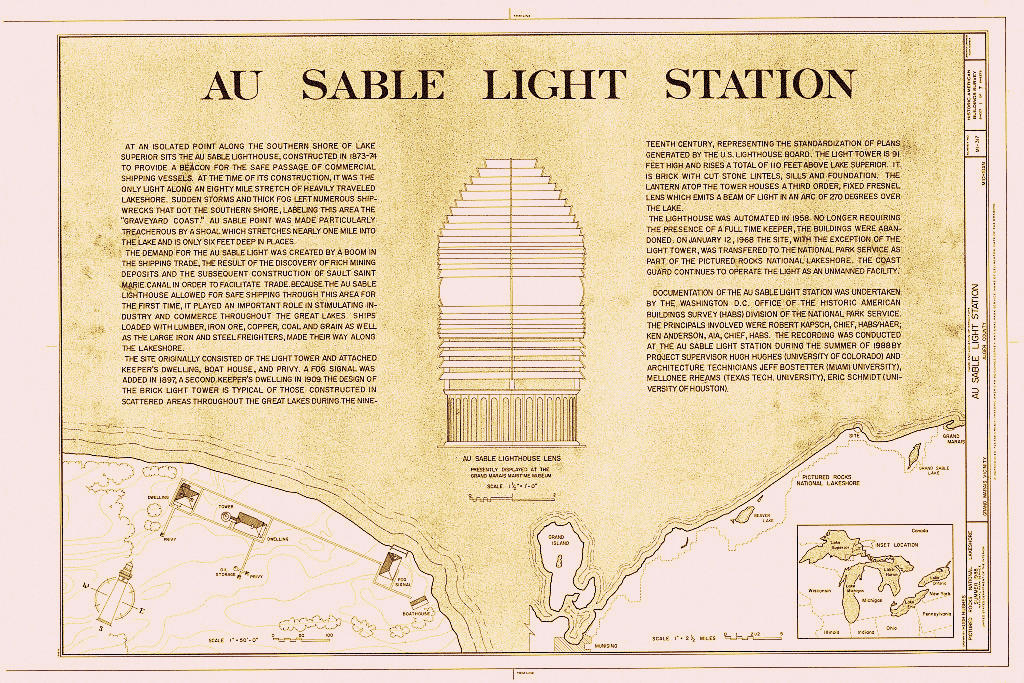
Survey Document of Au Sable Light Station from the Historic American Buildings Survey: Drawing of Fresnel Lens, Creator. Au Sable Light Station, Southern Shore of Lake Superior, Grand Marais, Alger County, MI. Documentation Compiled After 1933.
In the past issue (spring 2004), we asked our readers for answers to several questions on Great Lakes maritime matters. Though not all of our questions were satisfied, several were, to wit:
What is the meaning of fresnel lighthouse lens orders? GLHS Trustee Al Hart informed us that the lens orders referred to the rank of size as measured by inside diameter and height:
| Order | Height | Inside Diameter |
| First | 7’10” | 6’1″ |
| Second | 6’1″ | 4’7″ |
| Third | 4’8″ | 3’3″ |
| Third & 1/2 | 3’0″ | 2’5½” |
| Fourth | 2’4″ | 1’8″ |
| Fifth | 1’8″ | 1’3″ |
| Sixth | 1’5″ | 1’0″ |
How did a gas buoy flash? Capt. John Deck, Coast Guard Retired, tells us that back in the fifties he was involved with replacing the gas buoys with electric battery powered units. A flame in the gas buoy burned highly explosive acetylene gas contained by a pressurized bottle. Though not quite sure, he recollected that a small pilot light caused a very controlled explosion of gas when an adjustable needle valve admitted a critical volume of gas/air mixture into a thick glass walled combustion chamber resulting in a quick bright flash. Adjusting the needle valve determined the period of flash. Color of the lens glass determined red, green or white buoy characteristics.
Linda Rhodes, an Inland Seas Museum volunteer, offered an interesting paragraph gleaned from the internet web page stating in great detail the workings of Pintsch, Willson and American gas accumulator buoys, working on the carbide/water gas generation principle. How they flashed was not stated.
We received one response to our query as to the working details of a diaphone foghorn; how was the baleful bass bellow generated, from Garry Schiereck of Denver, Colorado, who came across this description in the International Maritime Dictionary, Second Edition, Van Nostrand Reinhold Co., Pub 1961: “A compressed air sound signal used by coastal stations in foggy weather and emitting a low powerful note, each blast terminating with a sharp descending note termed ‘grunt.’ The diaphone consists of a cylinder with slits cut in its walls, and a hollow piston with similar corresponding slits which slides in it. Compressed air forces this piston up and down rapidly, at each movement releasing a puff of air through the slits. This results in a very arresting and penetrating sound, which gives into a conical horn or trumpet a note of about 180 vibrations per second.” The “Letters” section of this issue contains an amusing recounting of life in the lighthouse exposed to an air driven diaphone for three days of constant blowing. Linda Rhodes also found an interesting description of the workings of air driven foghorns at [link no longer valid].
We were disappointed that no one knew what the flame lamps for the great fresnel lighthouse lenses were like. If any of you historians can enlighten us, please do.
Please send comments, questions, and letters to: John Burke and Andy Sykora, “I Have Always Wondered Why,” Great Lakes Historical Society at [address no longer valid].
***

