
Whistle Signals on the Lakes — Spring 2003

~
The Great Lakes… 84% of the continent’s fresh water… a different story in every drop.
By Roger M. Jones
Whistle signals on the Great Lakes have always been fascinating. Some were unusual — only used by U.S.-flag lakers. Ships all over the world use whistle signals to communicate with each other and — in some cases — tugs, locks, bridges and the shore. There are, of course, the official “rules of the road” which apply to the lakes as well as the ocean. These include the passing signals: one long blast, “I’m directing my course to the right or starboard;” and two long blasts, “I’m directing my course to left or port.” An important signal is the danger signal, which consists of short, rapid blasts, not less than five, which puts the involved vessel or vessels on notice of impending danger.
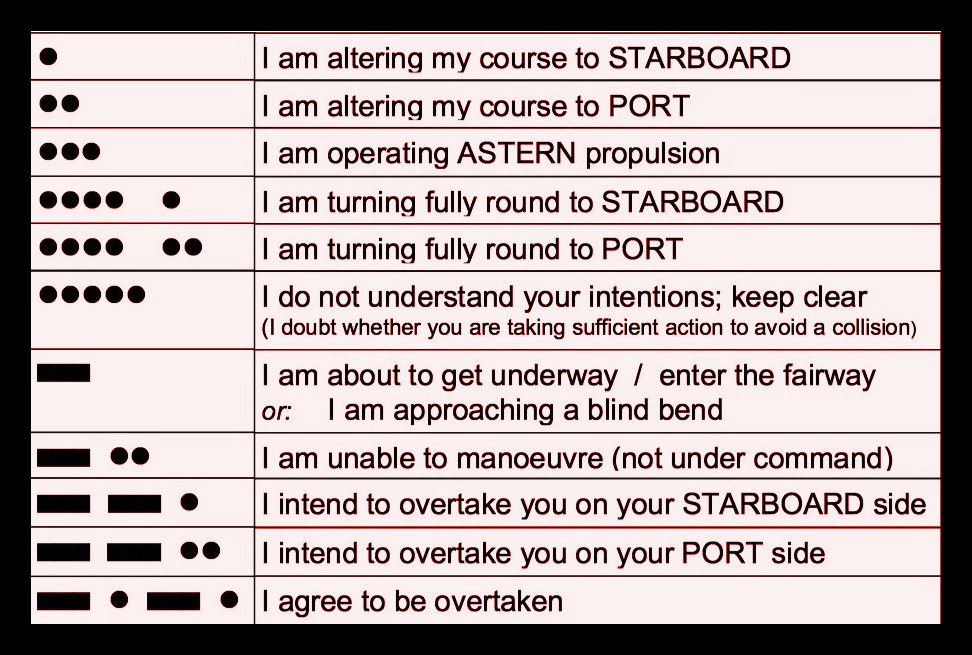
Common Signal Chart
Many persons around the Lakes are familiar with the three blasts at minute intervals used in fog, mist, falling snow and heavy rainstorms, blown by a vessel that is continuing to move in the inclement weather. If the boat goes to anchor, five short blasts are blown at intervals.
I remember situations when, in dense fog on Lake Superior, approaching Sault Ste. Marie (the Soo) downbound between Crisp Point and the Soo, seven to ten lakers would be forced to anchor. Six or seven would already be at anchor, each tooting five blasts at intervals when some bold captain would try to keep going and “crawl along” to get to the head of the line when the fog lifted. He would proceed very slowly, weaving through the anchored five blasters, continuously blowing his three blasts until he, too, finally anchored. When the fog lifted, you would see the entire anchored fleet, the ones closest to the Soo, hoisting anchor and starting to move.
One of the most interesting aspects of whistle signals on the Lakes was that, for many years, each fleet had its own whistle signal. In addition, each ship in the fleet had its own. George Ryan, former President of the Lake Carriers’ Association, told me in 2001, “I have no idea when it started (assignment of fleet and ship whistle signals), but it was well established in 1902 when the LCA Bulletins were published.” The Lake Carriers’ Association was the entity that assigned the fleet and individual boat signals. By the 1970s, fleet and ship whistle signals were seldom used and Ryan told me that by the time he took over as President of LCA in 1981, the practice had been abandoned.
There was a time on the Lakes, of course, when the whistle signals were “it” — the only means of communicating with another ship. Radio telephones came into use on the lakes in the 1930s and radar became standard equipment on lakers in the 1940s, right after the end of World War II. Ship identification whistle signals then became less and less useful and gradually their use was discontinued in the sixties and seventies. Of course, whistle signals applicable to rules of the road are still used.
The lever in the pilothouse that activated the whistle also activated a light high up on the forward mast, which was synchronized with the whistle. A long blast on the whistle produced a light on the mast of equivalent length and likewise a short blast produced a brief light. Many fleets had their company logo made up of lights on the mast (Cleveland Cliffs had a diamond in lights with a big C in the middle on the forward mast; Reiss ships had a big R in lights). When the whistle was blown, the logo would light up for the equivalent time of each blast.
Actually, if the wind was blowing in the wrong direction, the whistle signal could not always be heard by the other ship and the mast light would be the controlling signal. At night, or when running in bad weather, the on-watch watchman would always be at the very bow and was the one most likely to hear and/or see the whistle and light signal from another ship. The watchman would pass on what he saw or heard to the Captain or mate on watch in the pilothouse, as a double check on what was seen and heard from the pilothouse.
Some of the fleet signals in use for many years were:
American Steamship Company (Boland & Cornelius): — • — •
Inland Steel: — • • • —
Cleveland Tankers: — • • • • —
Oglebay Norton: — • — — •
An example of fleet and vessel signals would be American Steamship Co.’s Belle River. Whistle signal would be — • — •, followed by a short interval, then the vessel’s whistle signal
— • • •
Pittsburgh Steamship Company (later U.S. Steel fleet) had so many vessels (73 steamers and six barges in 1937) that, in addition to the fleet whistle signal, it was the only fleet that required a “Class” signal. There were three classes in the fleet. Thus, a Pittsburgh ship would blow the fleet signal followed by a short interval, then a Class signal followed by a short interval, and finally the individual ship signal.
When Class signals were still being used for Pittsburgh Steamship Company vessels in 1959 (subsequently as the Pittsburgh SS fleet became smaller, Class signals were discontinued), a typical signal, in this example for the William A. Irvin, was: Fleet Signal — • • — Class Signal — — Irvin’s own signal • • •
Purpose and Location
One of the most important locations when a signal was blown was for boats passing through the Straits of Mackinac. Ever since 1898, the Dagwell Agency at Mackinaw City had reported to the vessel owners by telegram their ship’s passage — and to newspapers in Great Lakes cities that carried lake “Marine Passages,” the name, time and whether eastbound or westbound of every ship that went through the Straits — all based on the whistle signals that all lakers blew. The officer on watch on each ship decided at what point in the Straits, based primarily on wind strength and direction, the Dagwell Agency at Mackinaw City was mostly likely to hear the signal. In 1960, the Dagwell reporting station closed. The owners were now communicating with their fleet by radio, and as lake fleets were disappearing or growing smaller, lake newspapers stopped carrying “passages.” The need for a reporting station at the Straits had effectively disappeared.
There were other situations and places where the fleet/ship whistle signals were blown. When ships were approaching certain ports to identify the ship to a shore entity, the signal was blown. Some fleets had their vessels blow their signal when passing the fleet flagship. Often it was blown when about to pass a home on one of the rivers where an active Captain’s family, or a retired Captain, lived. One of the most intriguing uses of the signal, which I remember vividly from my college summer sailing days — was to let crewmembers ashore know that their boat was unloaded and ready to sail. I remember crewmen being “up the street” in Ashtabula (usually in a nearby bar) when the boat was unloaded a little ahead of schedule and ready to sail. If all the crew weren’t on board, the Captain or mate on watch would blow the fleet/ship signal and within minutes, the last crewman would climb the ladder and the lines would be let go.
In the days before there was radio communication between ship and shore, there were standard whistle signals exchanged when a vessel was approaching a loading or unloading port.
What follows is just an example of some of the procedures outlined in “Whistle Signals,” a Lake Carriers’ publication dated May 1, 1920:
APPROACHING TWO HARBORS: If a ship is consigned to Two Harbors to load or to get instructions, proper signal designating fleet to which she belongs, and her name, should be blown when nearing this port.
DESTINATION ORDERS: When approaching Two Harbors, upon receiving: One long blast, a vessel is ordered into that port. One short and one long blast, a vessel is ordered on to Duluth. Two long blasts, she is ordered to Superior. Upon receiving the following signal — one short, one short and one short blast, the vessel will understand that she is ordered to turn back and proceed to Ashland for her cargo.
DOCK NUMBER: The particular dock where cargo is to be supplied will be designated by long blasts from one to six in number. These long blasts will be blown by siren. If cargo is to be taken on north side of the dock, the blast designating the dock number will be followed by one short blast. If cargo is to be taken on the south side of the dock, there will be no whistle following the whistles that designate the number of the dock.
These explanations continued for Duluth, Superior, Escanaba, Ashland, Mackinac, etc.
***

