
Investigating the Life and Loss of the 𝘞𝘦𝘴𝘵𝘦𝘳𝘯 𝘙𝘦𝘴𝘦𝘳𝘷𝘦 — Spring 2002

~
The Great Lakes… 84% of the continent’s fresh water… a different story in every drop.
By Edward J. McHugh
During the wee hours of September 8, 1892, the freighter Phillip Minch arrived in the Port of Cleveland. Named for the late founder of the P. G. Minch Transit Company, the Phillip Minch was the flagship of the firm. The company itself was a family success story. Having originated in Vermilion, Ohio, it had grown so large that a bigger port was needed to handle their increasing cargos. Nearby Cleveland, with its large port and industrial base, became the company’s homeport.
However, the Minch’s arrival on that late summer morning was something far more than a homeport visit. It was the final homecoming for Phillip Minch’s son, Captain Peter Minch and three others. Tragedy had struck the family and business earlier in August. Their ship, 𝘞𝘦𝘴𝘵𝘦𝘳𝘯 𝘙𝘦𝘴𝘦𝘳𝘷𝘦, was lost with all hands and passengers except one. The Minch was completing the sad duty of bringing home the bodies of Captain Minch, First Mate Fred Egglesby, Mrs. Mary Englebry (the Captain’s sister-in-law) and her child Bertha — all fatalities from the sinking of the 𝘞𝘦𝘴𝘵𝘦𝘳𝘯 𝘙𝘦𝘴𝘦𝘳𝘷𝘦.
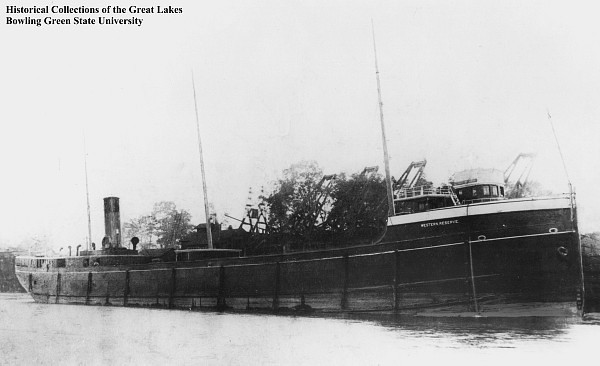
The Western Reserve in the water near the shore. BGSU Historical Collections of the Great Lakes.
At the time of her christening, the 𝘞𝘦𝘴𝘵𝘦𝘳𝘯 𝘙𝘦𝘴𝘦𝘳𝘷𝘦 was expected to sail the Great Lakes for decades. Launched on August 20, 1890, she was one of the new iron hulled ships. An exceptionally large vessel for her day, she measured 300’7 x 41’7 x 21′, with a gross tonnage of 2,392. A year later she proved her worth by setting a shipping record for gross tons of iron ore shipped in a single trip.
Unaware of her fate, the 𝘞𝘦𝘴𝘵𝘦𝘳𝘯 𝘙𝘦𝘴𝘦𝘳𝘷𝘦 began her final voyage on Sunday, August 28, 1892. Captain Minch, along with his wife, Anna, and two of their children, Florence (age 7) and Charles (10), boarded the ship in Cleveland for a trip to Two Harbors, Minnesota. Accompanying the Minch family was Anna’s sister, Mary Englebry, and her nine-year-old daughter, Bertha.
Captain Albert Myers, a veteran Great Lakes captain, piloted the ship. Under Myers was a seasoned crew of 22. Their passage would take them from Cleveland, across Lake Erie, up the Detroit River, across Lake Huron, into Superior to the port of Two Harbors. Under the hands of an experienced captain and crew, it should have been a scenic, uneventful trip.
The 𝘞𝘦𝘴𝘵𝘦𝘳𝘯 𝘙𝘦𝘴𝘦𝘳𝘷𝘦 left the Port of Cleveland light — no cargo; ballast tanks empty in her bow. This would allow her to travel at a higher speed. However, light and riding high in the water, the ship would have been less stable — her hull exposed to the stress and force of the lake.
Tuesday afternoon the ship passed Sault Ste. Marie. From eyewitness accounts, the passengers aboard the 𝘞𝘦𝘴𝘵𝘦𝘳𝘯 𝘙𝘦𝘴𝘦𝘳𝘷𝘦 were jovial, happily waving to the people on shore. The ship itself showed no sign of mechanical problems.
The 𝘞𝘦𝘴𝘵𝘦𝘳𝘯 𝘙𝘦𝘴𝘦𝘳𝘷𝘦 continued into Superior. But the pleasant afternoon at Sault Ste. Marie was replaced by a stormy, windswept evening on Lake Superior. As a precaution, the ship briefly took shelter in Whitefish Bay. Then, believing the worst of the storm had passed, she sailed out into open water.
At 9:00 p.m., 60 miles west of Whitefish Point, the ship suffered a mysterious death blow.
Without warning, a great crash was heard — the sound of splitting steel as the 𝘞𝘦𝘴𝘵𝘦𝘳𝘯 𝘙𝘦𝘴𝘦𝘳𝘷𝘦 began breaking in two. She was being ripped apart from the keel to the main deck behind the forward pilothouse. The force was so devastating that it continued up the main mast, splitting it in two.
The sound of the ship being torn in half signaled the crew that the 𝘞𝘦𝘴𝘵𝘦𝘳𝘯 𝘙𝘦𝘴𝘦𝘳𝘷𝘦 was going down fast. In less than ten minutes, the ship would disappear from the surface. The crew stationed in the pilothouse, including Wheelsman Harry Stewart, who was awakened from his bunk with the news that the ship was sinking, raced out of the pilothouse. Jumping across the growing fissure, that was breaking the vessel, they reached the other crew, passengers and lifeboats at the ship’s stern.
After the children were quickly placed in the wooden yawl with fourteen others, including Captain and Mrs. Minch, the boat was lowered from the doomed ship. Nine others entered the remaining metal yawl and lowered themselves into the stormy lake. One sailor, Fred Egglesby panicked and instead of entering a lifeboat, jumped overboard, becoming the first fatality.
The abandoned and mortally damaged 𝘞𝘦𝘴𝘵𝘦𝘳𝘯 𝘙𝘦𝘴𝘦𝘳𝘷𝘦 steamed on into the storm-tossed lake and within minutes, she was gone. However, tragedy did not end with the loss of the ship and her First Mate. The metal yawl, which may have been damaged, capsized shortly after its launch.
Desperately, the survivors in the wooden yawl went to rescue those from the metal yawl. Unfortunately only Harry Stewart, Bert Smith, and Wheelsman Carl Myers — Captain Myers’ son — were pulled from the raging water.
Now dangerously overloaded the wooden yawl rode heavy in the water, less than a foot above the waterline. The crew frantically bailed water while searching for life vests.
As the survivors worked to keep the lifeboat afloat, they spotted a steamship (later reported to be the Italia). Their shouts were not heard. An attempt to light one of the women’s shawls as a signal fire was unsuccessful and, tragically, the ship sailed on.
Now alone, the crew began to row back to Whitefish Point. Surviving the night, and within a mile of shore, the final tragedy occurred. Waves crashing over a hidden sandbar, capsized the overcrowded yawl throwing all 19 passengers into the water.
Martin Klasen, the 𝘞𝘦𝘴𝘵𝘦𝘳𝘯 𝘙𝘦𝘴𝘦𝘳𝘷𝘦’s oiler, grabbed one of the children. While attempting to tread water and keep the child afloat, he desperately screamed that help be given to the two remaining children. Unfortunately, he nor the others could survive the cold turbulent water. Only one, Wheelsman Harry Stewart, made it to shore alive to tell of the tragic events.
Exactly what caused the 𝘞𝘦𝘴𝘵𝘦𝘳𝘯 𝘙𝘦𝘴𝘦𝘳𝘷𝘦 to sink has remained a mystery. The storm that claimed her was not one of the worst to strike Superior. Many in the maritime community felt that the 𝘞𝘦𝘴𝘵𝘦𝘳𝘯 𝘙𝘦𝘴𝘦𝘳𝘷𝘦 should have easily ridden it out. She was only two years old, manned by an experienced crew, and her builder, Cleveland Ship Building Company, claimed she was one of the strongest boats they ever built. Yet the fact that she broke in two has led to the conclusion that something was wrong in her design or structure.
Either as a deadly coincidence or as evidence to support the theory of a structural or design flaw, the 𝘞𝘦𝘴𝘵𝘦𝘳𝘯 𝘙𝘦𝘴𝘦𝘳𝘷𝘦’s sister ship, the Gilcher sank under similar conditions less than a month later. But tragically no one survived the Gilcher to explain what happened.
Initially following the loss of the 𝘞𝘦𝘴𝘵𝘦𝘳𝘯 𝘙𝘦𝘴𝘦𝘳𝘷𝘦 some unlikely theories were offered. One explanation was that machinery in the engine room broke free and punctured the hull. This probably never happened because the ship’s engines continued running while she was sinking.
Another more fanciful theory held that the 𝘞𝘦𝘴𝘵𝘦𝘳𝘯 𝘙𝘦𝘴𝘦𝘳𝘷𝘦’s hull was pierced when she struck a rock. Yet she went down in deep water (600 feet) with no known shoals in the area.
The more accepted explanation to the 𝘞𝘦𝘴𝘵𝘦𝘳𝘯 𝘙𝘦𝘴𝘦𝘳𝘷𝘦’s loss was inferior steel plating used in the construction of her hull. If the hull or supporting structure contained inferior steel, when put under stress, the metal — instead of bending or twisting — could have snapped. And once a break began, it would have continued through the entire structure, literally splitting it in two.
The steel used on the 𝘞𝘦𝘴𝘵𝘦𝘳𝘯 𝘙𝘦𝘴𝘦𝘳𝘷𝘦 was made from the Bessemer Process. Bessemer steel had been used for years prior to 1892 with great results. Still, unless stringent controls and tests were made, impurities could have remained in Bessemer steel, reducing the steel’s ductility.
A fourth, but still plausible explanation to the sinking of the 𝘞𝘦𝘴𝘵𝘦𝘳𝘯 𝘙𝘦𝘴𝘦𝘳𝘷𝘦 was a design flaw. This was first expressed at the time of her construction. A foreman at the shipyard, Thomas Fitzgerald, complained to the yard’s superintendent, Mr. Coffenberry, that stouter material and better workmen be employed in the ship’s construction. To support his claim, he cited the problems found on the Pontiac.
Built in the same shipyard with similar design and materials as the 𝘞𝘦𝘴𝘵𝘦𝘳𝘯 𝘙𝘦𝘴𝘦𝘳𝘷𝘦, the Pontiac had to have her deck beams replaced. Under stress, the original deck beams had broken in two. Were the deck beams simply too small to withstand the load placed on them or were they made of weak inferior material?
For expressing his concern during the construction of the 𝘞𝘦𝘴𝘵𝘦𝘳𝘯 𝘙𝘦𝘴𝘦𝘳𝘷𝘦, Fitzgerald was dismissed from his duties. After her sinking he again came forward to relay the issues that he first raised during her construction.
Today evidence still exists that may offer an answer as to why the 𝘞𝘦𝘴𝘵𝘦𝘳𝘯 𝘙𝘦𝘴𝘦𝘳𝘷𝘦 went down — her blueprints, which can still be viewed and studied.
The midship section of the blueprints show the transverse framing (running from port to starboard) meeting the longitudinal frame (running from stern to bow). This transition is a critical moment in the ship’s structure. It is here where the stress and load on the ship is dispersed.
The midship view of the 𝘞𝘦𝘴𝘵𝘦𝘳𝘯 𝘙𝘦𝘴𝘦𝘳𝘷𝘦 shows the transition lacking. The stress point where the longitudinal load and the transverse meet, may be deficient in support. There is no additional bracketing where the framing meets. If even a small hairline crack were to form here, the added stress from the movement of the ship in a storm would split the hull from its framing.
Yet the ship’s drawings do not reveal conclusively that her framing failed. The exact cause as to why the 𝘞𝘦𝘴𝘵𝘦𝘳𝘯 𝘙𝘦𝘴𝘦𝘳𝘷𝘦 split in two remains a mystery. The answer, if one can ever be found, lies at the bottom of Lake Superior. Possibly by obtaining a sample of the ship’s plating (and hopefully its molecular structure has not changed), strength and metallurgical tests could be done. The results might determine if the steel was unable to withstand the stress of rough waters, or that the problem lay elsewhere.
After the sinking of the 𝘞𝘦𝘴𝘵𝘦𝘳𝘯 𝘙𝘦𝘴𝘦𝘳𝘷𝘦, Superior uncharacteristically gave up her dead. The bodies washed ashore near Deer Park on Michigan’s Superior coast. Even a relic from the great ship, her starboard light was surrendered by the Great Lake and found on a beach along Superior’s shore. It is now on display at the Lake County (Ohio) Historical Society.
Today a monument stands in Cleveland’s Woodland Cemetery marking the burial place of Captain Peter Minch, his wife Anna and two children, Charles and Florence. South of Vermilion, Ohio, at the Maple Grove Cemetery rest the bodies of Captain Myers and his son Carl. Mrs. Mary Englebry and daughter Bertha are buried in the Brownhelm Cemetery outside Vermilion in Lorain County. Martin Klasen is interred at the Scott Cemetery in Huron Township, Ohio.
It is reported that the bodies of sixteen others remain temporarily buried in the cemetery, now abandoned and possibly lost, behind Deer Park Life Saving Station in Michigan. They still await their turn for transport home to their family or church burial ground.
BIBLIOGRAPHY
Benford, Harry. Naval Architecture for the Non-Naval Architects. Society of Naval Architects and Marine Engineers Jersey City, NJ 1991
Bowling Green State University. Historical Collections of the Great Lakes. Jerome Library (6th Fl.), Bowling Green, OH
Cleveland Leader, September, October 1892
Cleveland Plain Dealer, September, October 1892
Cleveland Press, September, October 1892
Detroit Free Press, September 1892
Duluth Evening Herald, September 1892
Great Lakes Historical Society, American Ship Building Company Naval Architectural Plans, Vermilion, Ohio
Lake County Historical Society, Historical Society Quarterly, August 1965, Mentor, OH
Marine Review, September 1892
Sandusky Daily Register, September 14, 1892
Stonehouse, Frederick. Wreck Ashore: The U.S. Life-Saving Service on the Great Lakes, Lake Superior Port Cities Inc. Duluth, MN
Vanderlinden, Rev. Great Lakes Ships We Remember II. Freshwater Press Inc. Cleveland, OH 1984
Read More of Inland Seas Online

