
Rumrunning on the Detroit River — Fall 1997

~
The Great Lakes… 84% of the continent’s fresh water… a different story in every drop.
Author: Kathleen Warnes
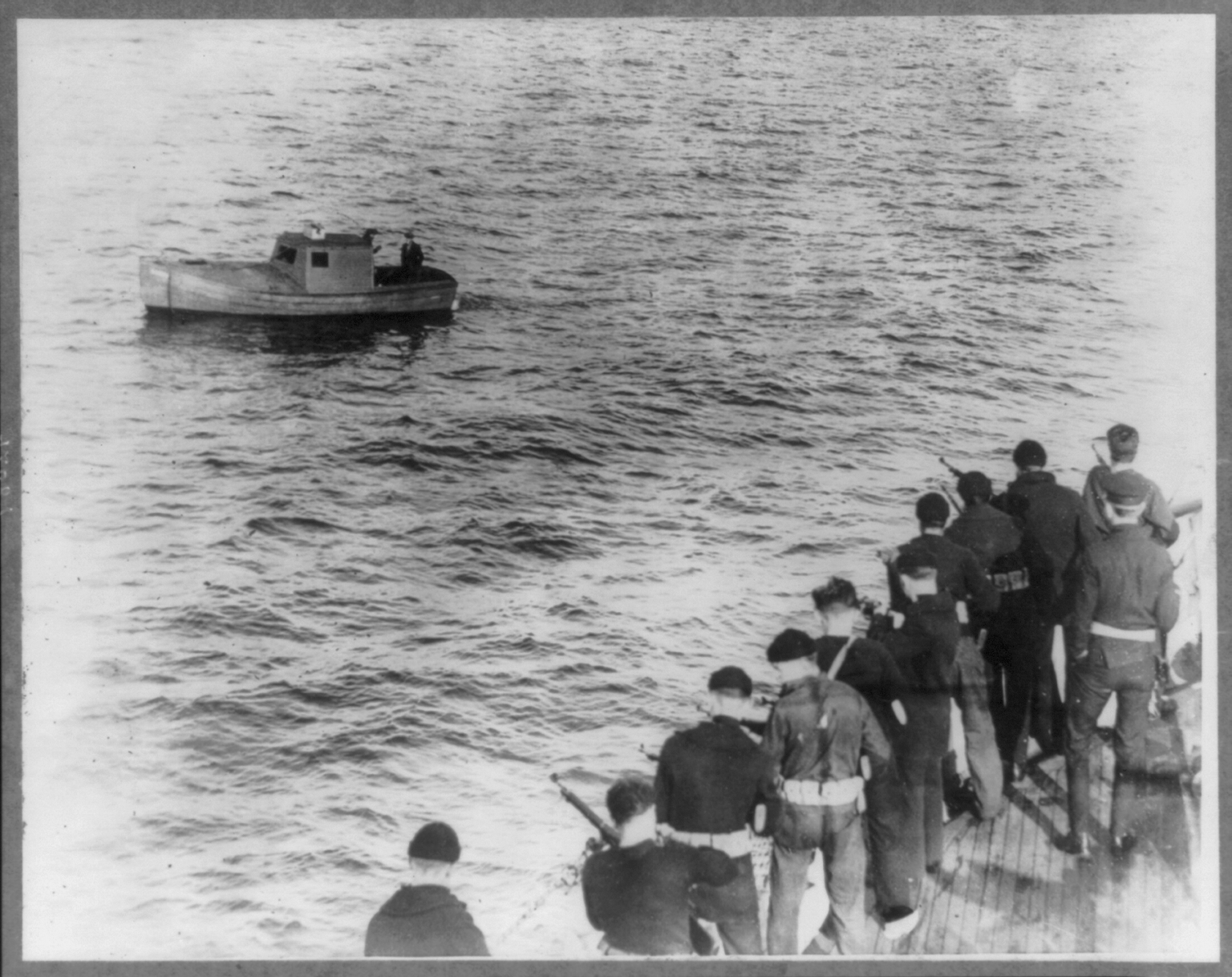
Rum runners…at the end of the chase. View from land of a small boat in the water with a man standing on deck. At least 11 armed law enforcement personnel are waiting on the dock. Library of Congress Prints and Photographs Division Washington, D.C.
On January 2, 1920, the Gray Ghost sailed his ice cutter across the Detroit River to Windsor, Ontario, to buy a motorboat license. This may have been the last law-abiding act he performed in his short life. During the Prohibition Years in America — 1920–1933 — the Gray Ghost and other Detroit River pirates and rumrunners, both professional and amateur, provided swashbuckling action enough to nearly rival Chicago.
Canadian breweries and distillers enjoyed a boom year in 1920. Customs officials in Windsor reported an unusual demand for motorboat licenses that year and in its early months nearly 25 percent of the Ontario population near the Detroit River participated in the illegal liquor business one way or another. Nearly 900,000 cases of liquor were shipped to the border cities during the first seven months of 1920.
The rumrunners even had more cause for celebration on August 11, 1921, because that was the day a Canadian police magistrate ruled that shipments of beer and liquor from Canada to the United States were lawful. More significantly, he ruled that the government had no legal powers to prevent the shipments. This ruling opened up a glittering world of rumrunning, roustabouts, and riches for the ordinary people of Detroit and Windsor.
Immediately, three workers from Ecorse, a downriver community, took their savings and traveled to Montreal where the sale of liquor was legal. They bought 25 cases of whiskey and drove back to Windsor. They rowed a small boat back and forth across the river until all of their treasure was ferried to the American side. They posted a lookout for Canadian and American customs officials just in case, but all went well. They sold their liquor in Ecorse and used the profits to finance a second and third trip. Multiply these enterprises by thousands and you have some idea of the volume of rumrunning across the river. Both Canadians and Americans with their secret caches of beer and liquor waited among the trees and tall grass on the Canadian side of the river. Boatloads of smugglers would glide across the river, signaling with pocket torches. A blue light flashed once and then twice — “all was clear.” A large sheet hung on a clothesline — “turn back immediately, police arrived.”
Rumrunning affected all of the downriver communities. Ecorse, especially, became the hub of rumrunning. Before Prohibition, the Detroit News described Ecorse as a “rather dull and undistinguished community . . . furnishing not a jot of interest, possessing scarcely a single arresting quality . . . best described as a nice place.”
Then the Eighteenth Amendment transformed Ecorse from boring to booming. Commercial fishermen, tugboat operators, shippers, dockworkers, and just ordinary workers joined the rumrunning profession. During the 1920s, the rumrunners in the downriver villages were the local business barons. Journalist F.L. Smith, Jr., wrote that “to have seen Ecorse in its palmy days is an unforgettable experience, for no gold camp of the old West presented a more glamorous spectacle. It was a perpetual carnival of drinking, gambling, and assorted vices by night and frenzied business-like community by day. Silk-shirted bootleggers walked its streets and it was the hub for the greedy, the unscrupulous, and the criminal of both sexes. When the police desired to lay their hands on a particularly hard customer they immediately looked in Ecorse and there they generally found him.”
Rumrunning boats by the dozen were moored each day at the Ecorse municipal dock at the foot of State Street, which ran through the village’s central business district. Rumrunners transferred their cargoes to waiting cars and trucks, while residents, police, and officials watched.
Some Canadian breweries set up export docks on the shore just outside of LaSalle, Ontario, which is directly across the Detroit River from Ecorse. Fighting Island, situated in the middle of the river between Ecorse and LaSalle, conveniently hid rumrunners from police patrols.
Rumrunning was no respecter of age in Ecorse. Ecorse rumrunners employed as many as 25 schoolboys as spies, lookouts and messengers. In 1922, police arrested a 15 year old boy delivering a truckload of liquor to a downriver roadhouse. The boy said that he was only one of several local boys working for the rumrunners. He insisted that he worked only on weekends and nights so he wouldn’t miss school. These 13 to 16 year old boys did such a good job as lookouts that the police couldn’t make unannounced raids on blind pigs and boathouse storage centers in Ecorse. They were usually spotted by the boys long before they arrived. One state police officer complained that “they spread out along the waterfront and are very awake and diligent.”
Arrests Won’t Stick
Federal and state officials more often than not had a difficult time making rumrunning arrests stick in Ecorse because the local police were in sympathy if not cahoots with the rumrunners. Rumrunners served on juries and the only cases from Ecorse tried successfully were the ones tried in federal courts.
A wild west style battle between law and order and the rumrunners and their defenders took place in 1928 in Hogan’s Alley in Ecorse. Several cars and three boats holding about 30 Customs Border Patrol inspectors gathered at the end of Hogan’s Alley to wait in ambush for the rumrunners. Rumrunning boats pulled up to a nearby pier and the agents rushed them; they arrested the seven crew members of the boat.
As soon as arrested, the crew members of the boat yelled for help. Rescuers rushed from all around. Over 200 people arrived to stop the agents from leaving with the prisoners. The people attacked the customs agents’ cars. They slashed tires and broke windshields. They pushed other cars across the alley entrance and threw rocks and bottles at the agents. Before the situation became too desperate, the agents banded together, rushed the barricade, and escaped.
State and federal agents raided the downriver communities, with only temporary success. In July 1922, Michigan Governor Alex Groesbeck ordered the state police, with the help of the federal agents, to occupy Ecorse, enforce the law, and clean up the downriver area. The raids did not begin to dry up the river of illegal liquor, so Governor Groesbeck established a permanent state police post near Ecorse to keep an eye on things. In response to the governor’s action, Ecorse village president and chief of police visited local blind pig owners and warned them that the state and federal officials meant business. The officials suggested that they destroy their liquor supplies to prevent more raids in Ecorse. The leading bootleggers conferred and verbally agreed that Ecorse would be liquor-free for 30 days. After the thirty days expired — business as usual.
The liquor business continued booming downriver. Every time federal and state officials swooped down on the liquor traffic, more liquor appeared and — business as usual.
After a series of brutal murders in the downriver area in 1931, Governor Wilbur Brucker sent the state police to patrol Wyandotte streets. But no state actions completely destroyed or even slowed the illegal liquor business downriver during prohibition.
The More Honest Bootlegger
John Wozniak of Ecorse is remembered as one of the more honest rumrunners. Wozniak’s early twenties coincided with the early rumrunning years. He was enterprising enough to form his own navy of twenty-five “tars” [from Jack Tar an old nickname for sailors based on the tar-treated canvas] to carry Canadian liquor into America across the Detroit River. His fleet went by the nickname Peajacket’s Navy and Wozniak gave his sailors standing orders to avoid violence and outthink law enforcement patrols. In keeping with their admiral’s nonviolent policy, Wozniak’s men did not carry arms, nor did Wozniak. When any of his men got caught, Wozniak backed him and his defense and paid the fine if the rumrunner was convicted.
Business Error
His love of sports helped bring the downfall of John Wozniak and his fleet. He sponsored a football team for Peajacket’s Navy and his team became well known in Ecorse, Lincoln Park, Wyandotte, and River Rouge. Law enforcement people would come to the games frequently to identify the rumrunners on Wozniak’s team.
Wozniak’s navy was successful because he successfully bribed Customs Border Patrol officials, but in 1928, the Admiral was arrested when federal law enforcement officials broke up a large bribery ring. At Wozniak’s trial he told the judge, “When I was indicted I was through for good. The law was getting too strong. I sold my boats and scuttled the others. I went into the automobile business and have done pretty well.”
Besides Ecorse, the hub for rumrunners, Lincoln Park, Ford, and Wyandotte were the distribution centers for Ecorse-landed liquor and liquor from these communities supplied big buyers in Detroit. The police chief of Trenton plotted with rumrunners to land their cargo in town with police protection. The River Rouge chief of police seemed to be an exception. “River Rouge is clean. There is no bootlegging here. My department will remain honest. But we have to cope with all the drunks and rumrunners and speeders from Detroit and Ecorse, Ford and Wyandotte. We collected $2,000 in fines from liquor violators last month and 90 percent was paid by Detroiters,” he said.
A Friendly Business
In the beginning rumrunning on the river was a friendly business — very few guns. The atmosphere was party and business was congenial. Women participated with men in the river bootlegging; the person in the next boat could be a local councilman or the school drama teacher.
Boat owners could transport as many as 2,500 cases of liquor each month at a net profit of $25,000 with the owner earning about $10,000. Some rumrunners made 800 percent profit on a load of liquor. The rumrunning boats were called the mosquito fleet. The only real perils of the sea that the rumrunners encountered during those first years were losing directions in the middle of the river at night and collisions with other boats.
The Ice Highway
The rumrunners and the Gray Ghost worked through the winter because people in Detroit didn’t go on the wagon in the winter. They just went on the river if they were thirsty. The river often froze solid and the rumrunners, including the Gray Ghost, took advantage of the ice road. They used iceboats, sleds, and cars to transport liquor from Canada to America. Convoys of cars from Canada crossed the ice daily. Cars on the American shore lined up at night and turned on the headlights to provide an illuminated expressway across the ice.
A prolonged cold spell in January and February of 1930 produced thick and inviting ice on upper Lake Erie and the Detroit River. Hundreds of tire tracks marked the ice trail from the Canadian docks to the American shore. On a February morning in 1930, a Detroit News reporter counted 75 cars leaving the Amherstburg beer docks. He wrote that ten carried Ohio license plates and headed downriver for south and east points on the Ohio shore. Others drove to the Canadian side of Grosse Ile. When they arrived on Grosse Ile, the liquor was unloaded into camouflaged trucks and driven across the toll bridge to the American mainland.
Most of the cars, however, drove from the Amherstburg docks to Bob-lo Park around the north end of Bob-lo Island. From there the trail headed west for about 2,500 feet to the Livingstone Channel. When the Channel was safely reached, the cars drove south for a mile, where the trail forked. One trail led to a slip on the lower end of Grosse Ile. The other fork led about two miles farther north. As the car drove, the road was about two miles from the upper end of Bob-lo Park to the Grosse Ile slip. Translated time-wise, it was about a six minute ride over the ice.
The dangerous part of the ride was along the Bob-lo Park side, where the ice was tricky. The rumrunners drove as far as they could with two wheels on the shore. The road from the upper end of Bob-lo Island to Grosse Ile was safe and the ice solid. The rumrunners did not try to hide their goods from the law. One of them told the Detroit News that “the law isn’t the thing we fear most. What we are really afraid of is the ice. Anytime it may give way beneath and let one of us through.”
The iceboats were the bane of the Coast Guard cutters because they were fast enough to be phantoms to the pursuers. Iceboats had obvious advantages over cars on frozen Lake St. Clair and the Detroit River. The Detroit News said that rumrunning by iceboat was “adventure framed in moonlight, and as grim as the romance of the buccaneers of the Spanish Main.”
Sail equipped iceboats could speed across the river in 12 minutes or less. Law officers did not have much hope of catching them. The Detroit News summed up the situation: “A gust of flying snow and perhaps now and then a trace of silver canvas in the wind and boats were gone.”
State police used tire chains on their cars when they pursued iceboats, but even the fastest patrol car on the lake could not keep up with the iceboats. “Get near the iceboat and there is a sudden tack, perhaps near enough to send an auto skidding for many feet, and the phantom rum smuggler is hundreds of feet away.”
The police would try to ambush iceboats at their destinations, but if vigilant eyes spotted them hiding on shore, the boats changed direction in a blink and were far downriver. The enforcement officers spent many a freezing night waiting for less sharp-eyed iceboat rumrunners.
Both police and rumrunners used their imaginations on the ice. Rumrunners nailed ski runners to boats and pushed them across Lake St. Clair or towed several behind a car. When the police got too close, the rumrunners cut the boats loose. The federal agents fit a spiked attachment over their shoes called ice creepers. But running with creepers was slow. Some rumrunners, knowing this, wore ice skates and gracefully skated away.
The Gentlemanly Business Turns Unfriendly
Then in 1921, the pirates, including the most famous one, the Gray Ghost, moved in. Go-betweens called pullers would carry cash across the river to the Canadian export docks for large purchases. Many of these pullers were robbed and killed and their bodies would be floating in the river. Often rumrunners would be [hijacked] on the way back from Canada, their cargoes stolen, and sometimes they would be murdered. In 1922, it was a nightly occurrence to find bodies floating in the river near Ecorse.
The Gray Ghost was responsible for a few of these, but generally he was a gentleman pirate and let his victims keep their lives. The most famous pirate on the river, his official title was pirate, extortionist, counterfeiter, and friend of the Purple Gang from Detroit. People called him the Gray Ghost because he piloted a gray boat, and dressed entirely in gray, including a gray hat and a gray mask. He carried two gray pistols and a gray machine gun. One of his favorite tricks was plundering pullers on the way to Canada. He would intercept them midstream, using his powerful speedboat and relieve them of their cash.
Distribution System
Once the rumrunners got the liquor across the river from Canada, they could dispose of it in several ways. Some syndicates paid farmers $20,000 or more to store liquor in their barns around Detroit. Others moved in, uninvited, to the docks and storage areas of the wealthy home owners along the Detroit River and Lake St. Clair.
Often, a sleeping Detroit tycoon would be jerked from his slumbers by gunfire and shouts of “Halt! It’s the police!” The night was often filled with yells, more gunfire, and the sounds of the chase. The rumrunners did not often get caught. To them, rumrunning was worth the risk because the political and police protection available made Detroit the principal port of entry for liquor smuggling from Canada into the United States. In 1922 alone, at least $35,000,000 worth of liquor came to Detroit through the 70 miles of river and lakefront stretching from Lake St. Clair to South Rockwood.
When the Gray Ghost went to Canada for his buying trips, he had a large selection of liquor from which to choose. On the Canadian side of the river, the exporters had rows and rows of liquor docks. They could replenish their stock from 83 breweries and 23 distilleries.
Some Financial Insurance
The Gray Ghost continued pirating without too much interference and disposed of his booty among the bootlegging syndicates of Detroit. One day he made a fatal error. He purchased a large load of liquor in Canada with a bad check and irritated some prosperous wholesalers. Five of the wholesalers kicked in $1,000 each and hired someone to insure against bad checks problems. The Gray Ghost was shot down on a Detroit Street from a passing car. The gunman was supposedly from the Purple Gang. The murder of the Gray Ghost was never solved. Neither was his true identity ever discovered.
The Worst Financial News On the River
The Volstead Act Repealed!
The rumrunners were devastated.
The stroke of the pen demolished a whole flourishing industry in December 1933. Even destroying Christmas sales.
When the Prince of Wales visited the United States he was asked, “What do you think of Prohibition?”
“Great,” he winked, “when does it begin?” The truth was — it never really did begin.
Read More of Inland Seas Online

