
Gus Hinckley – Lake Ontario Mariner – Summer 1992

~
The Great Lakes… 84% of the continent’s fresh water… a different story in every drop.
By Richard Palmer
The Hinckley had been steaming through a blinding snow storm for hours. No land1 beacon or buoy pointed the way. On every side, there was only whiteness. The captain guided his boat by dead reckoning while the crew prayed.
It was eight days before Christmas 19021 and the ship was en route from Cape Vincent to its home port, Oswego. Even before they had cleared the Cape breakwater, the storm had begun. Heavy seas buffeted them as they steamed south. The course was determined by compass and by computation of distance traveled, estimated from the boat’s speed.
Suddenly the sea calmed, and the voyagers bumped against a mountain of ice. Startled but undaunted, the captain held his bow against the berg while a sailor scaled it. So thick was the falling snow that the sailor was unable to see but a few feet. He reported, however, that a mysterious tower like structure stood at the edge of the ice. What this might be no one ventured to guess. But when further investigation revealed timbers beneath the ice, they drifted back until they reached the far side of the berg. There, to their mingled amazement, the crew found themselves at the entrance of Oswego harbor! The mysterious structure turned out to be the lighthouse.

Captain Augustus Hinckley as a young man. Image from the Coleman Hinckley collection.
Thus captain Augustus R. Hinckley won another battle against the storm. He was one of the few men who had ever sailed blind from the St. Lawrence River to Oswego. None of his companions ever forgot the anxiety of that passage. Henry Lake, the mate who climbed the iceberg, is said to have never sailed again.
Hinckley was one of the best known Lake Ontario captains. Despite the cloud of bad luck that followed him much of his life, he never gave up his love for the water. He knew the thrill of success against tremendous odds. Yet, a strangely malign fate dogged his course, and through no fault of his own, he saw wealth wrenched from his grasp and his most ambitious ventures come to naught.
He was born on Wolfe Island August 11, 1856 as the youngest son of a St. Lawrence River pilot of the old school. Even as a boy, his whole heart was set upon sailing. At an early age he took great interest in all things nautical and he was only a lad when he took up sailing as a career. His grandfather, Samuel, had been granted a license to run a ferry between the island and Kingston in the 1820s. The family retained the franchise for more than a century.
Gus’s father, Coleman Hinckley, piloted steamboats up and down the St. Lawrence River for many years and was somewhat involved in shipbuilding. By the end of his career, Gus Hinckley had his own fleet of ships, as well as a government contract to place buoys in the St. Lawrence between Cape Vincent and Morristown. In addition, his skill as a salvager in retrieving sunken ships won him wide renown.
One of Captain Hinckley’s first vessels was an old schooner called the Alberta. The origin of this ship is somewhat hazy, although official records state it was built by Hinckley at Cape Vincent in 1885.
It was named after a young lady who, it has been said, was the Queen of Simcoe Island that lies about three miles south of Kingston. Another account states it was built during the winter of1890 at Kingston and was a largish hooker similar to the barrel-bowed John Wesley.
The Alberta was 98 feet in length, with a round barrel bow and a square sawed-off stern, with an 18.1 foot beam and a seven foot depth, weighing 88 gross tons. (US 106355, Canadian 103648). She originally was a two-master with a center board to help her sail closer to the wind, as were most of the old flat-bottomed stone hookers. She carried plenty of canvas and was considered fast for a vessel in her class.
After being used as a sailing vessel or stone hooker for several seasons, Hinckley decided to rebuild her as a steam barge. He added some 18 feet to her bow and made her pointed the same as other steamboats, also adding a round stern, which increased her length to about 130 feet. He installed a boiler and engine, cabins, etc., and she was considered a pretty fair little steam barge.
He retained the foremast and used the canvas to help push her along at every favorable wind. Most of his later vessels were built in the same manner.
Captain William Stitt, master mariner of Toronto, said he first became acquainted with the vessel in the spring of 1899 “when I engaged with Capt. Hinckley as her master to trade between Coteau Landing, P.Q., and Montreal for the Canada Atlantic Railway in the grain, flour and package freight trades and we also towed one of the old K& P barges loaded with grain on this route each trip.
“On our easterly run we took grain, flour and package freight and on our westerly run iron, steel, cement and every class of freight for the Northwest. This was the year before the Soulanges Canal was opened and we were using the old Beauharnois Canal on the south side of the river, with its western entrance at Valleyfield. This canal was 13 miles long and had nine locks, 200 feet in length and carried only nine feet navigation. The Coteau Landing harbor was dredged out of the beach just east of the government pier with a lighthouse on the end of it.”
“The basin was dredged in a north direction from deep water for1,800 feet, and a width of 400 feet with freight sheds on one side and the grain elevator on the other side. Railway tracks ran from the yards down to and alongside both sheds and elevator. It was a most modern and up-to-date terminal.”
“The Coteau Landing terminals commenced about the year 1895, were finished in the fall of1899. After the Soulanges Canal was finished in 1900 and also the other St. Lawrence canals and channels were deepened for 14-foot navigation and vessels could come right through from the Great Lakes to Montreal without lightering, and about that time the Canada Atlantic was absorbed by the Canadian National Railways, so Coteau Landing terminals were closed down as they were not needed. The completed harbor only had a life of one year.”
“The C.N.R. had their own terminals in Montreal so the harbor was scrapped, the elevator and freight shed taken down, railway sidings and yard cleared of the steel and buildings and today nothing remains but the ruins of what was once a beehive of activity day and night.”
“The life of the terminal was short, only about five years from start to finish.”
“About Oct.15, we left the Coteau-Montreal run and went in the coal trade between Lake Ontario ports, Bay of Quinte and St. Lawrence River for the balance of the season.”
In November the steam barge was in Oswego loading hard coal for Kingston. Weather had been fine since commencement of the lake trade. Captain Stitt said “we had two nice runs from Charlotte to Bay of Quinte ports and it was fine and calm and everything pointed to another fine run that night to Kingston. After trimming the hold full and battening the hatches down we ran 75tonsof grate coal on deck which left us with about a foot of freeboard.”
This was one of Captain Hinckley’s practices which often got him into trouble and lost him his vessels. Stitt said, “while the mate and crew were making the boat ready for sailing about 4 p.m. I went to the custom house to get my clearance, and on the way ran into a Mr. Clarke, who was shed foreman at the Coteau Terminal when we traded there.
“He had returned home to Kingston the week before, and with his wife and baby had come over to Oswego to visit some relatives. When I told him we were loaded for Kingston he wanted to know if they could ride over with us. The weather seemed perfect so I consented and told him to get his wife and baby and join the boat at the O & W trestle.”
“When I returned from uptown, friend Clarke and family were on board, so I gave them my room for the trip over. It was just 6 p.m. when we were passing out the piers and the cook ringing the supper bell when we saw one of the men from the lifesaving station raising the storm signal for a strong nor-easter. The lake was as calm as a pane of glass, but the sea gulls were all in on the breakwater, a SUI’e sign of dirty weather, and our ship’s barometer also going down. But it’s only 28miles to Stony Point and 30 miles to the Galloo Island, the Big Galloo and the Little Galloo, about four hours run and we could find shelter if necessary.”
“We didn’t want to go back and get caught in Oswego for two days and sometimes a week at this time of year. I have seen 60vessels stormbound there for over a week. It’s a nasty place to get out of when the wind blows off the lake. So we stood on.”
“At 8 p.m., when on our course to Galloo and Kingston, and about 16 miles out of Oswego, it became intensely dark and some light snow began falling. We had lost sight of all lights for the past hour, and there was considerable dead roll from the north which always precedes a storm on the lake.”
“At 8:30 a terrific gale from the northeast hit us, accompanied by hail and snow, and it was impossible to look into it. It fairly lifted the water off the lake, and in less than ten minutes heavy seas were washing right over the vessel. All these steam barges at that time were fitted with a heavy mast forward, used for hoisting the cargoes from the hold and also for the foresail, and when not in use these were furled up and lashed to the booms and lowered down to within five or six feet of the deck.”

The steamer HINCKLEY with Cat. Hinckley standing in the pilot house door. Image from the late Coleman Hinckley.
“In bad weather a life line was run from the mast to the railing forward of the pilot house, which was always aft on these small steam barges. This was the way the crew got forward and kept out of the heavy seas washing over the deck and got protection behind the turtle deck forward where the sounding pipe ran down to the keelson. Even at that it was a dangerous job in heavy weather.”
“Now, while the storm is at its worst outside, let us look inside of the cabins and in the fire hold and engine room.”
“All the crew, except the chief engineer, Jack Barber, myself and my passenger, Mr. Clarke, had gone down with seasickness early in the storm. They were laid out everywhere and dead to the world and, I guess, didn’t care if the ship did go down. Mrs. Clarke was deathly sick, but the baby slept through it all. The cabin furniture was strewn all over and many pieces broken, and it kept Mr. Clarke busy keeping his wife and baby from rolling out of the berth.”
“The cook was mixed up with pots and pans behind the stove which remained solid, being bolted to the floor, but everything else in the kitchen and dining room was torn down and in most cases broken.
“But the big fight was being waged down in the engine room and fire hold. Chief Barber, up to his knees in water in the fire hold, was fighting away to make enough steam to keep the water down and prevent it putting the fires out, which would mean Davy Jones’ locker for all of us. It was impossible to keep over 60 lbs. of steam, and with our deck awash things looked pretty black.”
“I was about as busy as the chief trying to hold the ship head-on, and holding myself when she took those awful rolls and lunges in the extra big whitecap seas that every once in a while, lifted the ship almost on end. Minutes were like hours during the height of the gale, and the night seemed endless.”
“I had seen thousands of lights in my imagination during the night for I knew we were pointing towards that grand old Galloo Light that has guided so many mariners across in some pretty tough weather — and many lost, too — but while there’s life there’s hope.”
“I was in constant touch with the chief engineer by speaking tube. At 4:15 in the morning it was blowing just as hard and snowing, and black as ink, but the sea was going down and I knew we were coming under the island and called to the engineer and told him to keep the good work up and we would soon get shelter. He said the water was almost in the furnaces.”
“I turned back to the wheel again and to my joy there was the grand old Galloo Light — and the fog whistle — and in less than two minutes we grounded in the southwest side of Galloo Island on the sand beach.”
“It’s surprising how quickly the crew came to when they saw terra firma, and got busy on the pumps, and at 9 a.m. we floated off the bottom and repaired our storm-battered hulk as best we could, and as the wind and snow died away in the afternoon we ran down through the Stony Island channel and out by Grenadier and across the head of Wolfe Island to the Batteau channel, and arrived in Kingston early the following morning.”
“We saved all the cargo below deck, but lost the 75 tons on deck and both our lifeboats. All the crew soon came to, but Mrs. Clarke, who was a blonde when she came on board at Oswego, left the boat at Kingston with many ‘silver threads among the gold.”
“I parted company with the Alberta that same fall, but I heard after that she burned and was beached at almost the same spot on Galloo Island that we landed on that stormy trip.”
The Alberta was first registered at Kingston by Hinckley, then of Cape Vincent, on Ap1il 21, 1899. On Oct. 25, 1901 she was sold to Amanda Smith of Belleville. It was destroyed by fire lying at the wharf at Trenton on Oct. 8, 1902.
Hinckley’s largest setback was the loss of the Pentland (US #150656) 827 g.t. 617 n.t. 192.8×35.5×14.3, built at Grand Haven, Michigan in 1894 by Duncan Robertson for the old Pentland Steamship Co. In 1916 she was owned by the Coastwise Steamship Co. and in 1921 by the Ontario Trading Co. of Ogdensburg.
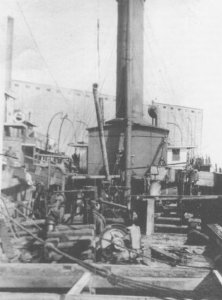
Raising the steamer PENTLAND at Port Colbourne in the 1920s. Image from the Coleman Hinckley collection.
On November 22, 1921, she was upbound in ballast, from Montreal to Oswego, Capt. John J. “Jack” Powers, master and part owner, when she ran hard aground at Weaver’s Point, three miles from Morrisburg. The Donnelly Wrecking Co. of Kingston was called to the scene but was unable to take her off, and there she remained until the following spring. Her exact location was on the north shore of Gooseneck Island. In June,1922, she was purchased by John E. Russell Salvage & Wrecking Co., Ltd. of Toronto, but was shortly thereafter sold to Capt. Hinckley for $800.
By his own unique methods, Hinckley was able to refloat the Pentland with seemingly little effort. He then hauled her to the channel and steamed her to Ogdensburg and into the St. Lawrence Marine Railway for survey and complete refit. It is said that a Cleveland concern then offered Hinckley $30,000 for her, but he refused to sell. A short time later, the Pentland struck the breakwater at Port Colbourne and sank, but he again raised her. The Pentland was finally abandoned in 1928.
One by one, his ships vanished, until the last of his fleet, the pet of his own designing, the Hinckley, crashed on Stony Point during a storm. The vessel sprang a leak on July 29, 1929 while en route from Fair Haven to Gananoque with a load of coal. There was a choppy sea running and when well down the lake from Oswego, the steamer developed a leak below the water line. The pumps were put to work but the leak became worse and water flowed into the hold faster then it could be pumped out. When a short distance from Stony Point Light the boat began to settle and it was feared it would founder in deep water. The crew abandoned ship, but Capt. Hinckley remained aboard and finally brought the steamer up on the table rock in Gravely Bay.
Finally, Captain Hinckley, by now in his 70s, said, “The best thing for me to do was to go forward and drop in. I forgot that I hadn’t been in for years. I jumped in with all my clothes on, even my boots. The first wave caught me. After that, I was more careful.” Although her owner reached shore, the Hinckley broke up in the gale which followed.
The Hinckley was built in 1901 in the ship yard of Frank Phelps in Chaumont (US #96578) 211 g.t. 177 n.t. 144.4×24.0xl0.0. She was rebuilt in 1920 to 232 g.t. 188 n.t. and depth deepened to 11.7 feet. She carried a six-man crew and had a 150 horsepower engine.
Another vessel owned by Hinckley was the Isabella H., named for his daughter. Much like the Hinckley, she was also built at Chaumont (US #213102) 248g.t. 141 n.t. 100.8×25.9xll.11915. This vessel was rebuilt from the old McCormick (91938) built in Grand Haven, Michigan in 1887 and purchased by Hinckley about1909. The McCormick was abandoned as unfit for service in June,1911, at Chaumont. Her original dimensions were 106×24.7×8.0.
The McCormick ran between Oswego and Montreal and handled buoy services in the spring and fall for the U.S. government. When Hinckley bought her, he rebuilt her with a built-up forecastle, deepened her, and added a steel A-frame.
On September 28, 1925, the Isabella H. and the Hinckley were entering Oswego Harbor with loads of stone when the former vessel apparently sprang a leak and started to sink rapidly. One of the mates, Hiram Bush of Gouve1neur, N.Y., lost his life when he drowned. The rest of the crew was rescued by the Coast Guard. At the time there was a storm running on the lake.
The Isabella H. listed heavily to port, but came to rest squarely on the flat rock at the harbor entrance. Eventually, the vessel broke up. Another one of Hinckley’s vessels was the tug Chippewa (US#75818)built in Philadelphia, Pa. in 1875. She was 43 g.t. and 21 n.t. and foundered off Weavers Point on Aug. 12, 1920.
Captain Hinckley’s ventures on Canadian waters brought him into conflict with the Canadian Pilots Association. One day, here called, a shot came across his bow, and he was escorted to Montreal. His dual citizenship of an earlier period came in handy for him. He proved to the authorities that he had as much right in Canadian waters as any other pilots who questioned him. He was never again bothered.
His first experience as a wrecker was with the steamer George T. Davie of the Montreal Transportation Co. which sank with a cargo of grain near Alexandria Bay in the St. Lawrence River on June 12, 1911.
The Calvin Co. of Garden Island made several attempts to raise the barge and finally abandoned it. That November, Hinckley signed a contract to raise the vessel. Although the stern of the wreck lay on a ledge of rock, the bow was in 65 feet of water.
Hinckley said he had passed up and down the river, noting the fruitless efforts of Calvin to raise the Davie. When he received the contract, he brought three vessels and 16 men to the scene. After drydocking the barge Jessie and schooner Bertie Caulkins at Kingston, he had holes bored through their bottoms at the stern, forming eight 10-inch wells in each. Through these were dropped two-inch iron chains, capable of lifting 50 tons.
When Hinckley’s little squadron finally anchored above the Davie, he was prepared to raise 1,000 tons. Divers were sent down to pass the chains beneath the wreck. Hatches were secured, pipes attached, and pumps started. As water came out of the hulk and jacks began to lift, the Davie came up between the two improvised wreckers. At first, it rolled in the chains, going over on one side. Hinckley hastily assembled his discouraged crew, praised their efforts, and instructed them to lift carefully on the chains on one side. The Davie rolled back.
Hinckley cleared several thousand dollars on this job. Such feats won for him a wide reputation as an expert salvager. He lived in Oswego during most of his sailing days and is still remembered by older residents of that city as the “little old man with the leaky boats.”
After a number of financial set-backs, John S. Parsons, the noted Oswego ship chandler, ran the “Hinckley line” for two or three years until Hinckley got back on his feet. “He didn’t handle money too well,” remembered Jack Donovan of Oswego, who worked for Parsons in his store, referring to Hinckley.
“I remember him as a little withered old man who used to come into the store to pay off Mr. Parsons with a gallon of maple syrup or a dozen eggs. Mr. Parsons was always ready and willing to help down-and-out sailors.” Donovan said.
He added that one of Hinckley’s problems with boats was that he would load them so heavy there wouldn’t be a foot of freeboard. The last cargo carrier he owned was the steamer Harvey J. Kendall (US #96166) built in Marine City, Michigan in 1892. He had purchased her in 1930 from the George Hall Corp. of Ogdensburg to replace the Hinckley. At the time, the Kendall was at about the end of its days and its hull was badly deteriorated.
The following story is related by the captain’s nephew, who sailed on her during her last trip before it sank in the Cardinal Canal.
Written by Theodore Hinckley, Cape Vincent, 1973.
This is what I remember of my trip on the Harvey J. Kendall under Capt. Gus Hinckley. This was the last contract he had to pick up Coast Guard buoys under civilian contract. The Coast Guard took over the following year.
Uncle Gus stopped at the Cape about the middle of December. Some of his crew had quit and gone home, and he lacked a couple of deckhands and a coal passer (fireman). So George Cody, Earl Snyder and myself hired on to go down river with him and pick up buoys as far as Waddington, which were the last in American waters Cody was fireman (coal passer), Snyder and I deckhands. The old Kendall was about 400 tonnage … she had a high steeple compressed steam boiler which had a lot of leaks around about, here and there, but still worked. The engineer’s name was Woods, of Alexandria Bay. Cody’s relief coal passer was called “Pipe Boiler” Paddy, from Oswego, built like Cody, tall and lean, waist about 32″, he wore a pair of overalls the engineer had discarded, but wrapped around once again. We all got a bang out of seeing him with that outfit on. He was almost as dirty as the overalls with coal dust.
The hoist man was Jimmie Cree, from Morristown. The mate was from Alex Bay… forget his name. Aunt Lydia was the cook and Captain’s wife. He couldn’t find a cook for the trip and was cutting expenses as much as he could because he had bid too low on the contract.
Uncle Gus had tied up at the depot dock in Cape Vincent, so as I said before, about Dec. 15th we shoved off and sailed to pick up buoys. Earl Snyder could not go as his father, J. P. Snyder, had refused him permission. So I was deckhand and coal passer combined. We picked up buoys all the way down river and unloaded them at Ogdensburg. Then got buoys from the harbor there and went down river to Waddington and got the last of the buoys. It had turned very cold the night we left the ‘Burg and was making ice in the canals and bays, so we ran the river and with the current made good time to retrieve the last buoys at Waddington. My duties were to work on deck while we were taking buoys aboard and pass coal on to the fireroom floor (deck) while underway. The meals were nothing to talk about with any praise, and Auntie did as best she could… a roast beef went a long way; first roast beef, then hash and finally soup, everything else the same, a ham served about four different ways and the bone ending up in pea soup. I don’t think anybody undressed fully at night. I know I didn’t. Our quarters were too cold, but that didn’t freeze the bugs out. They were in full power.
The blankets and bunks were sure loaded. I left my socks and underwear on, so only got hit around my wrists, ankles and neck, little red spots showed up good every morning, but I was so damn tired at night I slept anyway. We had seven spar buoys, three nun and two big flasher buoys on board when we finished up at Waddington and started back for the ‘Burg about the middle of the last day.
Uncle Gus figured he could make it back by working the eddies along the shore out of direct current, and he was right only for one thing. Some how and some way the draft damper in the stack had come loose and outside balance arm showed draft wide open. But it was only half. Guess the set bolts had slipped, as we discovered later. We knew it was making ice in the canal and as the Kendall was wood, we didn’t want to chance it. So we started up river bucking the current. It seemed to go pretty good as I was passing coal and couldn’t look out the ash chute hole and get a sighting on shore. Cody was fireman and Woods kept at him for more steam and Cody kept after me for more coal. Finally I told Cody get a sight on the shore, as we were just holding our own and that was all.
The Captain was whistling for more steam, but we just couldn’t make it. So he swung in nearer to shore to catch an eddy and hit bottom just like three steps … bump, bump, bump, and there we stayed. Tried to reverse and everything else, but no good so Capt. Gus had the idea to put the hatch cover across the jolly boat and have myself and Jim Cree take it out in the river astern to act as a keg anchor. But this didn’t pan out because the mate and I both rebelled. If the lifeboat tipped over when we were to dump anchor we both would be goners as the water was ice cold. So we sent the word by having a farmer call Kingston, Ontario and contact the Salvage Queen to come and get us off.

The steamer HARVEY J. KEDALL – one of Captain Hinckley’s vessels. Image from the University of Detroit Marine Historical Society.
Next morning the Salvage Queen arrived and dropped anchor above the Kendall, then played out cable till we got cable from her stern. Then she winched up on the prow winch till she was half way to the upper anchor. Then she started both winches and using herself as a big winch, she pulled us off the rocks. All the power the Queen had was in the winches, her motor was not very much, and she couldn’t buck the current, so we both dropped and entered the canal below Cardinal. We tied up there to inspect the hull, but no bad leak showed where we were on the rocks. Uncle Gus said it was ledges and no boulders, so just the keel and forefoot were hit, not damaging the hull. The two Captains talked things over and decided the Queen would lead, the Kendall to follow as there was about three inches of ice in the canal. Meanwhile, Uncle Gus had engineer Woods, and Cody check the damper in the stack, and they found the set bolts had loosened. So the damper showed full on outside and only half opened inside. It was adjusted and okayed.
The Salvage Queen started out but couldn’t make it as the ice was too thick, even though she had a steel hull. But new ice was tough so she called Kingston for the Salvage Prince, as it had lots of propeller power and had an ice-breaking bow. But it couldn’t get there until the following day.
Well, Gus didn’t want to wait and said we’d try it as the Kendall had power enough but was only ironed part way on the bow which he figured was enough. So we started out of the lock for a ways, it was okayed, but then new ice started. We’d make 200 or 300 feet, then back and ram again. The poor old ship took a beating when we hit the ice, but would go good, deck humping up and down like an ocean roll, then stop, back and hit again. Finally, about a quarter of a mile outside of Cardinal, Cody the fireman called me to pass more coal. I stepped off the fire room floor into about four inches of ice water in the coal bunker. I hollered to Cody, “Better get me a pair of rubber boots as there’s water in the bunker.” The engineer and Cody both came in with a lantern and you should have seen the engineer’s face when he showed the light in the bunker. The coal bunkers were in the stern near the fan tail and every time we backed, the stern would hit hard in the ice, and that had started the seams leaking. It was spouting pretty good into the coal bunkers. He notified Uncle Gus so we stopped and he held her into the ice.
But nothing could be seen above water, the bilge had already been sounded and was gaining at a good rate even though we had two pumps going. Capt. Gus decided if we could get to Cardinal we would stop and lay up as it was getting dark at that time of day. We made four more lunges at the ice and came to ‘Dodge’s’ coal dock outside of Cardinal. Capt. Gus called for me and I jumped onto the dock. It was icy, but I hung on. He whistled for go ahead and I thought he had left me, but it was just to break ice up so he could get closer to the dock.
Finally he backed up and I took a line and made fast fore and aft. By this time the old Kendall was making water pretty good and it took a lot of coal to keep up steam. We had a four inch bilge pump and two two-inch steam siphons going full blast besides generator and steam for the engine boiler. The only way I got coal on the fire room floor was to rake it out of the bunker with the big fire rake. After we tied up, water was sounded for depth in the canal and we found if she did sink the upper works and top of spray rail between fore and aft would be out of water, even though the keel was on the bottom.
Well, Gus had the engine shut down and he told Woods to keep the pumps going full. He would be back inside of an hour and away he went into the night. It was really dark by this time. I got a pile of coal ready for Cody and he said to me, “It won’t be long now,” even though there were still rats in the galley, we wouldn’t go under and being tied to a dock.
I couldn’t help but laugh even though it was bad luck for poor old Uncle Gus. The water started to creep up on the fire room floor. Woods told Cody to pull the fire as ice water would blow up the boiler if it was hot. So Cody dumped the fire and we climbed topside. Everybody got their gear together and were standing by as pumps and generator started slowing down for lack of steam, when we heard a team of horses on the run coming down the road. A couple of people were yelling. Into the coal shed and onto the dock came Uncle Gus and a farmer riding a wagon of horse and cow manure straw mixed, just as the lights dimmed and the steam siphons quit. It was kind of gruesome, the Kendall groaning and settling and the only light was from the flashing top of the buoys which stuck out of the hatchways on deck.
They bumped the deck as the old ship went down, but stayed in the hold. Of course Uncle Gus was mad as a hornet, but Woods told him he was afraid of blowing the boiler if ice water bit the hot grates. The engineer knew what to do as he came off the ship all dressed up and had his bag packed in 10 minutes. He had been ready long before. Maybe I better explain the load of straw and manure that Uncle Gus got. In the old days of wooden vessels if a bad leak developed in the seams under water the caulking loosened or was pushed through. If the vessel wasn’t in too much current or under way, sometimes wet sawdust or manure with lots of straw mixed in it would, when dropped over the side settle along the hull and be sucked into the seams which were leaking. This would lessen or stop a leak so that temporary repair could be made. But I don’t think 40 loads would have saved the old Kendall. Uncle Gus had me swing down to the galley wall through a hole topside by the top of the boiler, to retrieve a clock. We had hand lights (flashlights) and also went forward and got Aunt Lydia out of the Captain’s cabin where she had been all this time.
We went on the dock and into the coal shed where we called Cardinal and had cars come and get us. Uncle Gus did not have much cash on him, but hon-owed some from Mr. Dodge who owned the coal dock and he gave us each $20 on what he owed us.
The spar and nun buoys were floating on deck, held there by the fare board which was just out of the water. When the ship settled on the bottom the lights flashing were on big gas buoys and that’s how we left the Harvey J. Kendall.
We, the crew, took a bus for Prescott and then Ogdensburg. We had to wait in the station at the ‘Burg for a train to Watertown. Cody and Paddy disappeared, but showed up back in a half an hour. Both were pretty well fixed, so I butted in “Where and how?” Paddy said, “My boy, if you get stuck in a strange place and need anything, don’t go to the police or anyone else, but ask the fire department. They know everything.”
So he and Cody found some booze that way. Well, we all chipped in and got some more except for Uncle Gus and Auntie. They had rented a room in a hotel for a day to rest up. Paddy still had on those overalls Woods gave him and a great big overcoat donated by the same Woods. He was sure a sight, but good natured and we had a time … everybody singing and laughing . . . we took over the smoker on the train to Watertown, even the conductor joined us, after hearing our story.
Cody and I left Watertown for Cape Vincent and the others went home. When I got home I told Laulie, my wife, that I had better strip off my clothes on the outside porch, and while I did that, to start the tub running, as I needed a hot bath real bad. It was cold that day, but we had to fumigate my clothes and other gear just the same. I got home three days before Christmas, 1930.
Read More of Inland Seas Online

