
Jewel of Lake Erie C. 1989 – Fall 1989

~
The Great Lakes… 84% of the continent’s fresh water… a different story in every drop.
By Ellen NicKenzie Lawson, P.H.D.
If someone took the time to engrave this lighthouse of Northern Ohio on a silver spoon, citizens of the region could do no less than they did to save this “jewel of the lake.”
Back in the mid-1960’s when Congress established the National Trust for Historic Preservation, one of the oldest save-the- lighthouse campaigns in the country began in Northern Ohio on Lake Erie.
Local preservationists began organizing in July 1965 when the U.S. Coast Guard announced plans to destroy the lighthouse a mile from shore at the entrance to the harbor in Lorain, Ohio. This structure, built in 1909, was not old by preservationists standards, but many felt it was a local symbol of all that was best about a shipbuilding and steel-making town with few aesthetic landmarks. Simple in design, the lighthouse in Lorain was a favorite with sailors, tourists, and others who liked to watch the sun set on Lake Erie.
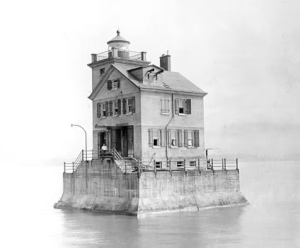
Lorain Lighthouse. Image courtesy of the United States Coast Guard.
The first to take up the fight to save the lighthouse was the local newspaper, The Lorain Journal, whose editors understood that a new $22 million dollar harbor reconstruction with automatic beacons made the lighthouse unnecessary but wondered, “Why is tradition ignored sometimes in the name of progress…There are some values in life that are not measured by money alone.”
Next to take up the cause was city councilman William Parker, whose home overlooked the lighthouse.
Still another was local businessman Wayne Conn, who lived on the lake and had seen the sun rise and set behind the lighthouse for over 40 years. Conn, who chaired a local committee to save-the lighthouse, reminded others that the lighthouse was “one of a very few remaining evidences of a fast disappearing era in Great Lakes shipping.”
On the other hand, local Coast Guard officials said they would just as soon see the old lighthouse torn down. But with the help of then-Congressman Charles Mosher, who arranged a meeting with Coast Guard officials in Washington D.C., the Coast Guard agreed that the lighthouse was in good structural shape and could be donated to any local group dedicated to its preservation and maintenance.
All these negotiations took place within two months of the announced demolition of the lighthouse. Then the contractor insisted on going forward with the demolition unless he were paid $6000 to be released from the $20,000 con- tract. Journal cartoonist Gene Patrick drew the lighthouse on the auction block, “Going…going…” Two young schoolgirls wrote the paper asking “How would you like to be in our lighthouse’s shoes, if it had any?”
Then fate intervened. Unusually bad weather that fall of 1965 made it impossible for the contractor to proceed. Also, until the underwater cable was laid to the new beacons, the old lighthouse was still useful. The city council did what it could to delay matters by referring the Coast Guard request for a new utility pole placement near the harbor to committee for further study. As long as this pole was not in place, no underwater cable could be laid and the old lighthouse could live.
At this point the subcontractor announced he didn’t need to lay cable to the new beacons before the lighthouse was destroyed as there was little traffic on the lake in winter and by spring the beacons would be working. So plans went ahead to destroy the lighthouse. Conn circumvented this by directly contacting the Chicago-based contracting firm which agreed not to destroy the lighthouse until the spring.
By then the U.S. Coast Guard in Washington, at Mosher’s prodding, agreed to retain the lighthouse because of its “historic value.” A Journal cartoon showed the lighthouse wiping its forehead in relief.
For the next seven years all was well. Then in 1974 North Ohioans learned the Coast Guard had turned over the lighthouse to the General Services Administration and it was for sale to the highest bidder.
The Associated Press picked up the story and ran a dramatic shot of the lighthouse at sunset in papers all over the world. A. paper in Bombay, India captioned the photo, “Must see to appreciate. A place to get away from it all. Sorry, we don’t know how many bathrooms it has, but we can. show you the magnificent view of the setting sun.” Californians reading the Los Angeles Times learned “Ohio just might be the place for sunset watching.” And tourists reading the Paris edition of the New York Herald-Tribune learned of a wonderful light- house for sale in Ohio!
“If people all over the world think the Lorain lighthouse is interesting, why shouldn’t we?” asked Journal editors who then began a deliberate policy to feature artistic photographs of the lighthouse over the next decade.
Conn reactivated his lighthouse committee, took local businessmen out to look at the structure, and urged G.S.A. officials to visit the town to see the lighthouse firsthand. Ohio State was interested briefly for aquatic research; and the Great Lakes Historical Society in Vermilion expressed some interest; but no buyer was forthcoming.
It took three years, but finally in 1977, the Lorain lighthouse was sold for $1 to the Lorain County Historical Society. In 1979 it was listed on the National Historic Register.
But the building badly needed repainting. The greater Lorain Chamber of Commerce, under Bob Kowalski, organized local businesses to contribute more than $30,000 in time and products to paint the lighthouse. Glidden Corporation donated the paint and a local business provided the barge. More than 17 organizations were involved. Some of the volunteer painters were men who could not swim if they fell from the scaffolding!
“The lighthouse, jewel of the lake, sparkles once again,” wrote the Journal. Glidden ran a full-page color ad of the lighthouse in national boating magazines bringing Ohio more good publicity.
In the last decade, the Lorain lighthouse has become a popular Northern Ohio symbol. Photographers, professional and amateur alike, find it a challenging subject. Painters try to recapture its moods in oil and watercolor. Local seamstresses recreate needlepoint images of it. A local company sells the image on T- shirts. One Avon Lake man began building working scale models of it and went on to complete models of all the lighthouses on Lake Erie. The lighthouse even adorns local Christmas cards sold by the chamber of commerce.
One indication that the Lorain lighthouse is a structure of enduring value worth retaining, no matter what the odds or the cost, is a silver spoon with the image of the lighthouse engraved on it which surfaced in an antique store in Maryland soon after the committee-to-save-the-lighthouse was formed over twenty years ago.
Read More of Inland Seas Online

