
Fresh Water Flat Tops – Winter 1987

~
The Great Lakes… 84% of the continent’s fresh water… a different story in every drop.
By Brian Higgins
It was a pensive Admiral Yamamoto who turned his aircraft carriers home- ward from a ravaged Pearl Harbor, 7th of December in 1941. The Japanese attack had taken the lives of young men and old ships. The new American carriers on a mission to Wake Island escaped certain destruction.
The Japanese knew that the aircraft carriers and their vital air crews held the key to victory in the Pacific.
The United States quickly realized the importance of the aircraft carrier with its complement of highly trained pilots. Aircraft carriers would be required to replace the island airfields lost to the Japanese in the Pacific. In the Atlantic it became evident that the merchant ship convoys required the protection from aircraft carriers. German submarines were vulnerable to air attack and could not track and ambush the convoys at their slow submerged speed. American ship yards were quick to build the carriers, but it was more difficult and time consuming to build a corps of expert air crews. Where to train the pilots?
Japanese submarines had shelled the American pacific coast. German submarines were sinking allied ships in the Atlantic within sight of the beaches at an alarming rate. Pilots required considerable practice in operating from the pitching short deck of an aircraft carrier. This practice required radio traffic that would have served as a beacon to prowling enemy submarines. The carriers were even more vulnerable in that they had to sail straight given course for long periods of time.
The Great Lakes were unique in World War II as the large body of water totally protected from enemy attack. These inland seas also offered varied weather conditions, ideal for training pilots for action in any part of the world. While the United States had the luxury of a safe haven, there was a problems in that we had no carriers on the lakes, and none could be brought in through the narrow Welland Ship Canal.
The solution was to convert some of the fine old passenger ships of the Great Lakes. Thus was born the fresh water flat tops.
 The Seeandbee was the euphonious name of the 500’ luxury liner sailing under the C & B Transit Line flag. She sailed her maiden voyage from Detroit to Buffalo as the largest sidewheel passenger ship in the world. She called on most of the major ports in the Great Lakes and carried up to 2300 people. In 1942 she was to become the first aircraft carrier on the Great Lakes, the Unclassified Miscellaneous Auxiliary (IX) #64, more pronounceable the Wolverine.
From her conversion at Buffalo yards she sailed for Lake Michigan in 1942 to train naval aviators. On October 27, 1942, she briefly held the spot light, being visited by the Commander in Chief of the United States Fleet, Admiral Ernest J. King. For that brief period and true to naval tradition, she carried the four star flag as the ranking ship in the U.S. Navy. The fun loving old Seeandbee had come a long way as the ranking warrior of the Navy, if only for a few hours.
The Greater Buffalo shared with the Greater Detroit, the honor of being the largest passenger ships at 535 feet when launched in 1923. She was built at the US Shipbuilding yards at Lorain, Ohio, and finished in Detroit. She also sailed under the flag of the C & B Transit Line. Shortly after the outbreak of the war, she sailed to Buffalo and berthed next to Seeandbee. Thus began her conversion as the second, largest, and last of the fresh water flat top fleet. She was given the classification of IX 81 and named Sable. Within months she joined Wolverine on Lake Michigan. Neither ship stored aircraft on board, but they participated in the training of thousands of pilots. A prime collection of naval aircraft from unsuccessful sorties still adorns the bottom of Lake Michigan. The war ended, as did the military careers of Wolverine and Sable.
Both ships were taken to supposedly safe mooring while their fate was pondered by politicians and financiers. There were plans to turn them into restaurants or hotels in Milwaukee and Chicago. As time passed, so did any hope for survival of these two historic ships. A last attempt was made by the newly formed Great Lakes Historical Society at Vermilion to use Sable as a museum ship and protective breakwater at Put-In-Bay. Money was not available, a familiar bell that has tolled for many a fine old historic vessel. Inattentive security in Illinois resulted in looting of these ships of most of their valuable artifacts. Quickly it became evident that there would be little left to save. Their fate was sealed.
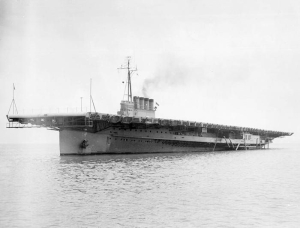 The Tug John Roen III came for the Wolverine. the end of a tow line, a short haul to Milwaukee, and the scrappers torch put an end to her. The Sable’s death was more difficult. She left Chicago in 1948 for the scrappers in Hamilton, Ontario. Twenty eight feet of beam had to be cut away for her to fit through the Welland for her date with destruction. There was a brief outcry about a foreign nation cutting up an American warship, but to no avail. Sable joined Wolverine as a rusty pile of scrap steel.
Both Wolverine and Sable are special ships to remember for their unique place in Great Lakes history. Both were the largest Great Lakes passenger ships at the time of their construction. Both were the only aircraft carriers ever to sail the Great Lakes. They were the only coal burning U.S. carriers during World War II. Wolverine and Sable were the only side wheel propulsion aircraft carriers ever to sail. Wolverine was the only U.S. Navy ship to fly the four star flag on the Great Lakes. Surprisingly, only two other nations had more carriers in operation than the Great Lakes fleet during the Second World War.
Read More of Inland Seas Online

